

SOSX Investment
Read the data room. See the whole ecosystem.
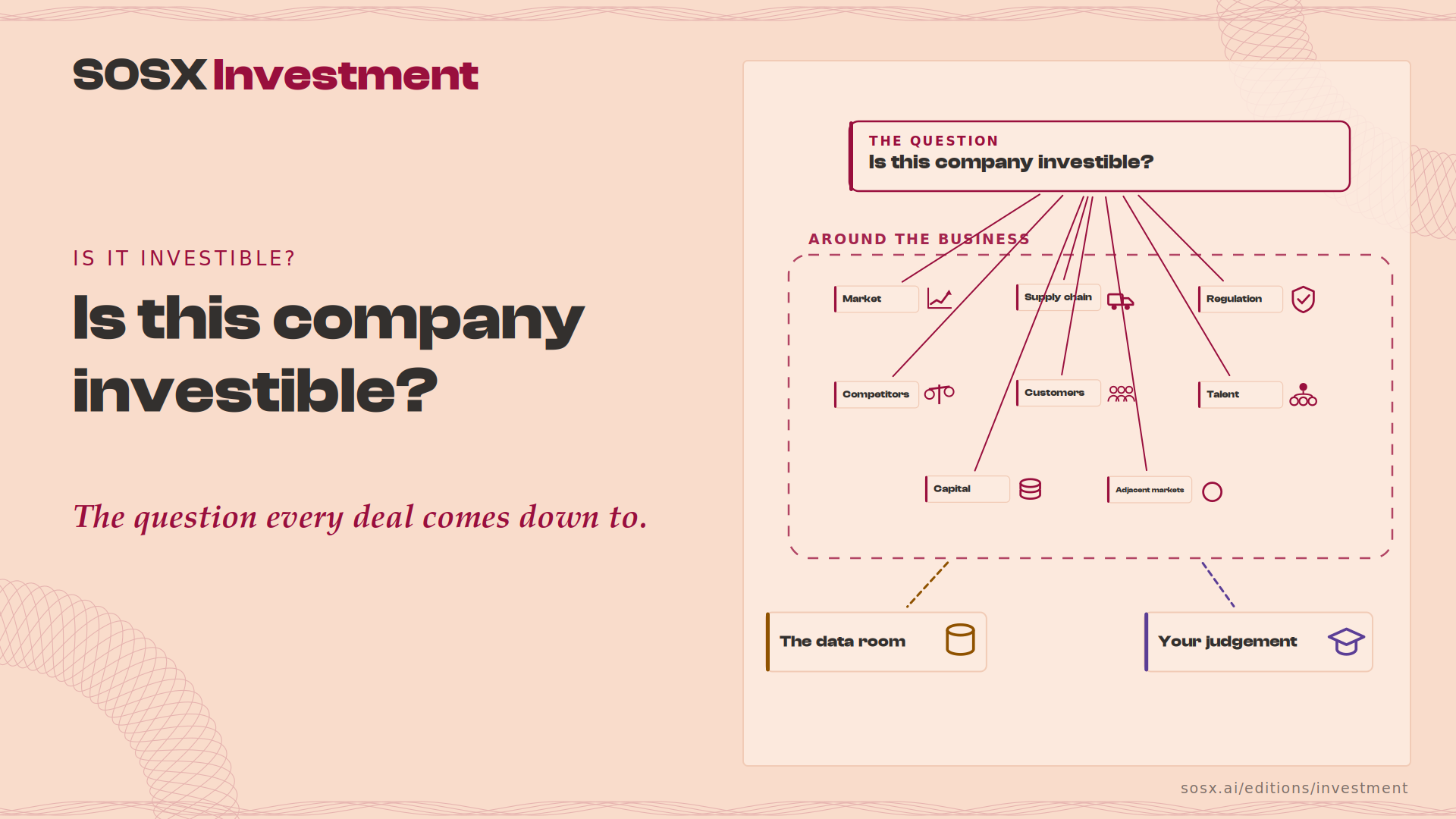
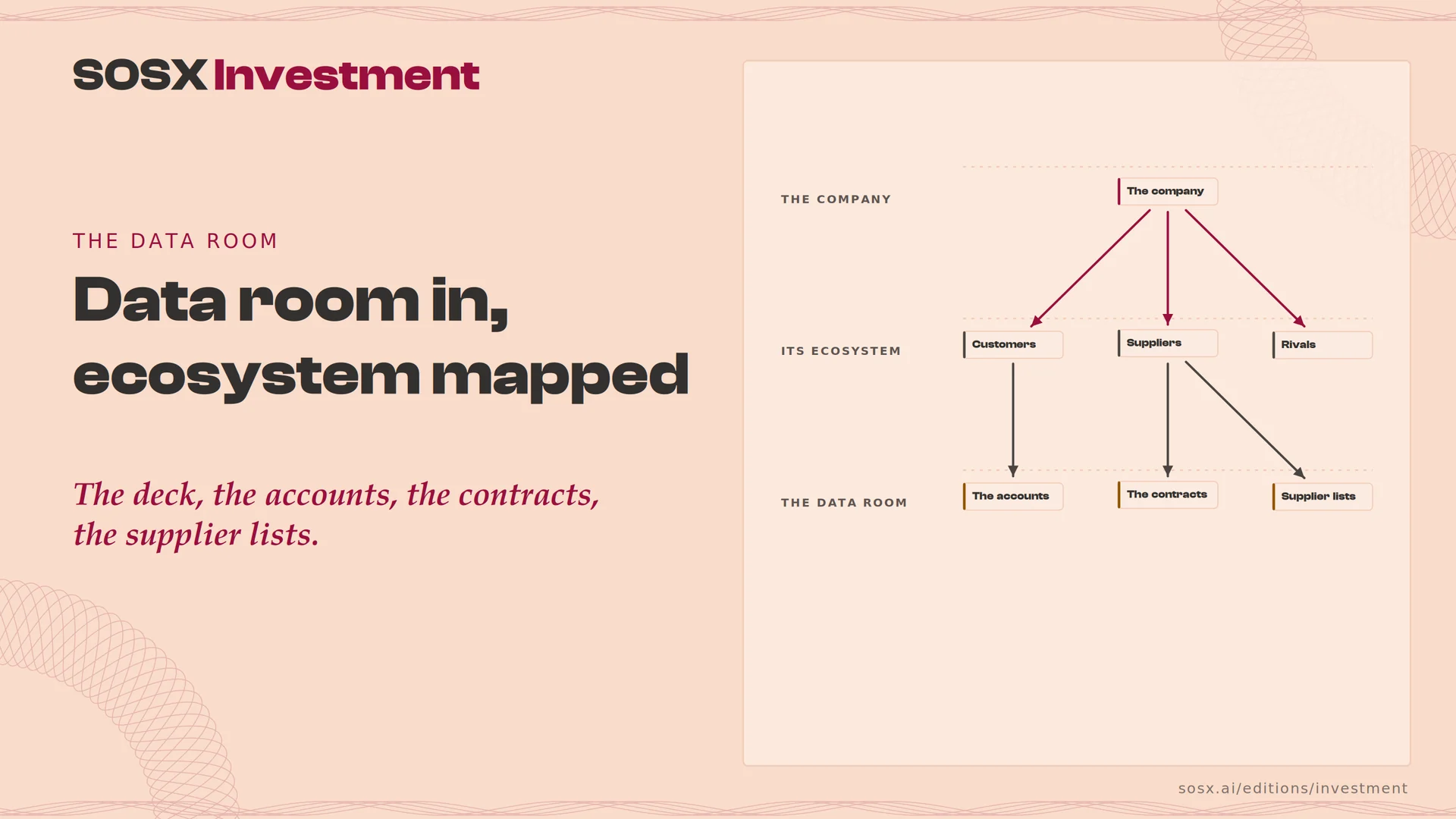
Is it investible? SOSX Investment takes in the data room, maps the business and its ecosystem, and analyses prospects, the strength of the moat and sensitivity to disruption and dependencies, then keeps watch on the companies you back.
The problems it solves
- “The data room is vast, and the decision is due this week.”
- “How strong is the moat, really?”
- “What happens to this company if a rival, a supplier or a platform moves?”
- “Once we’ve invested, we hear about trouble at the next board meeting.”
SOSX Investment: Is this company investible?
See SOSX Investment at work
The same engine as Just Good Business 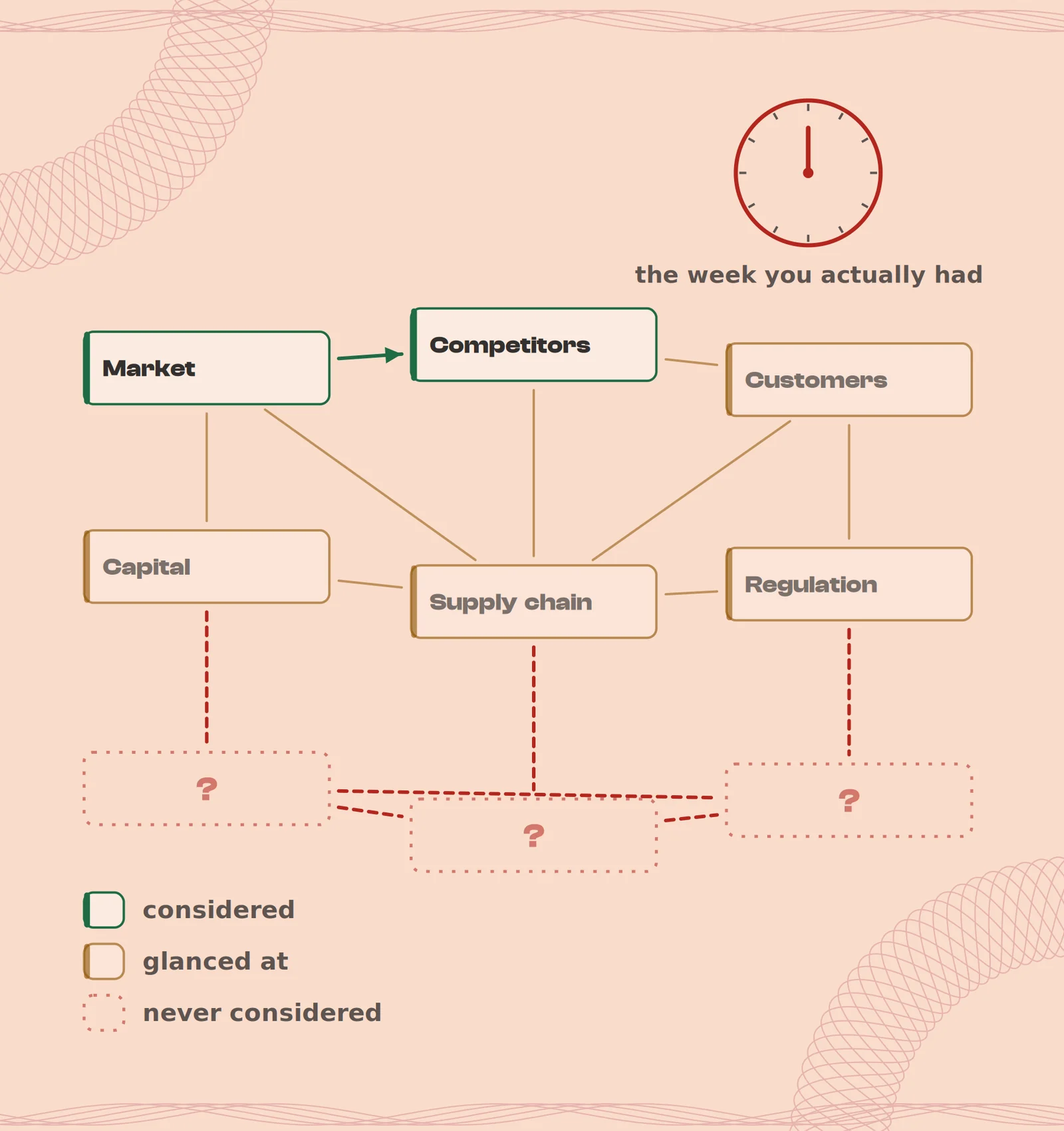
The question behind the question
How SOSX helps
Research
Specialised agents research the question, every claim citing a source.
Build
One typed, connected network, every value with its units and confidence.
Analyse
What-if, feedback loops, dependencies, trade-offs, risk and ROI.
Report
SWOTs, risk registers and decision reports, red-teamed before you see them.
The detail
For when you want the whole argument.
Read moreWhat SOSX Investment does
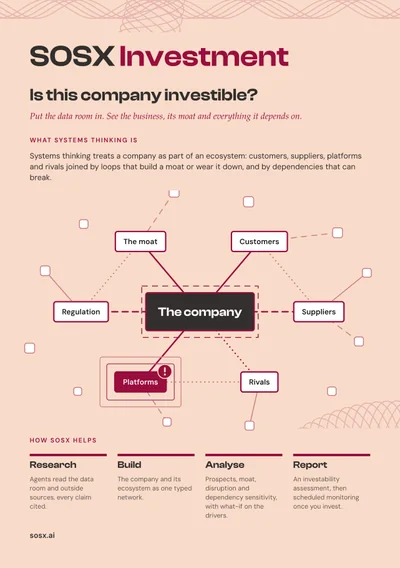
Is this company investible? SOSX Investment starts where the evidence is: it takes in the data room, and maps the business and the whole ecosystem it operates in (market, customers, supply chain, regulation, competitors, capital) as one connected model.
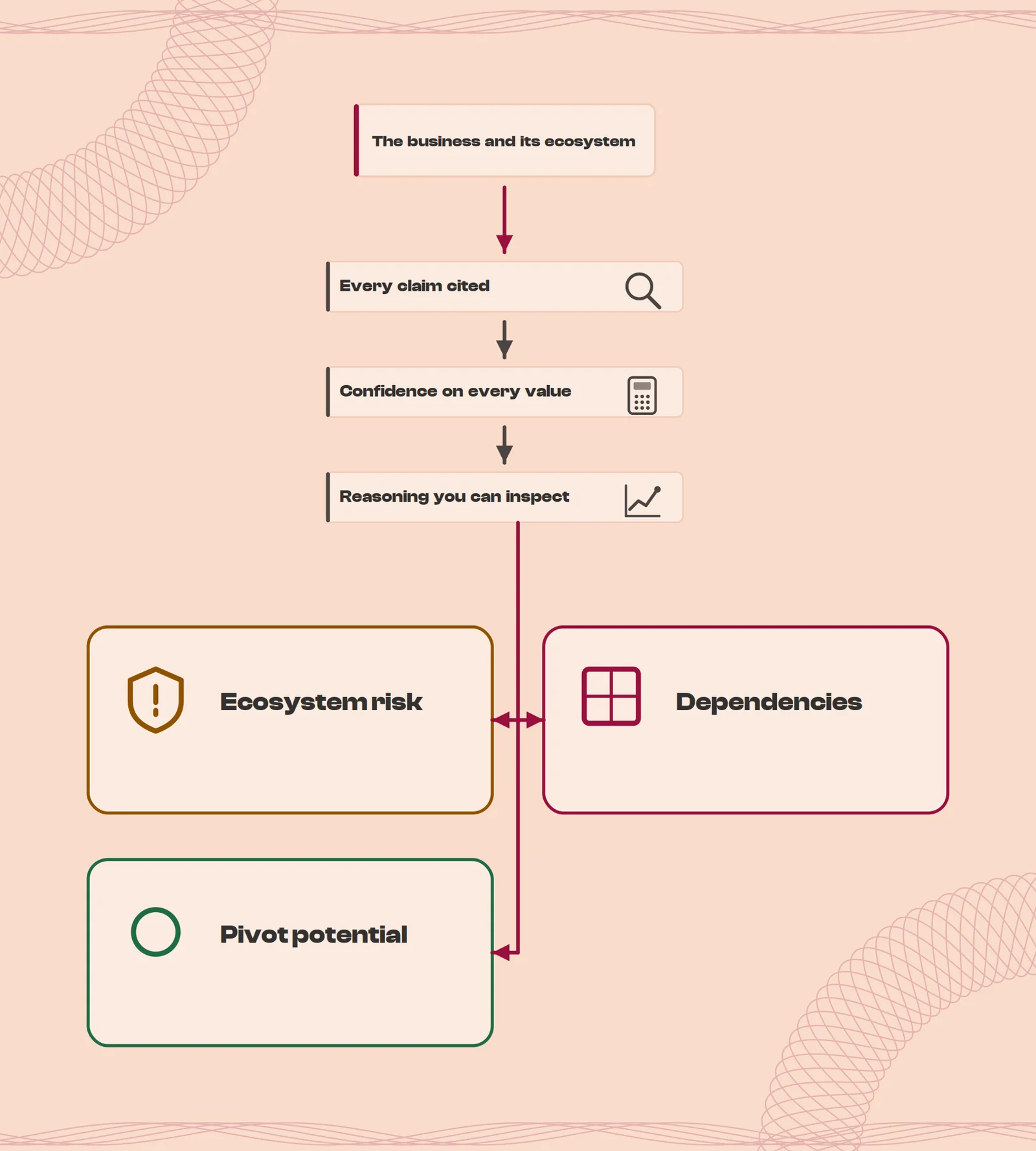
Then it runs the analysis private investors need. What are the business's prospects? How strong is its moat? How sensitive is it to disruption, from other players or from the dependencies it relies on? Every claim cites a catalogued source and every value carries its confidence, so you can see where the model is sure and where it is not. One model, two readers: the owner reads it to decide what to change, and you read the same model from the other side of the table to decide whether to back the change.
And it does not stop at the investment. For the companies you back, scheduled agents keep on top of what is happening around them, and tell you when something that matters moves.
The register is set by our founder's own framing, which we hold to: investment is not only a data game. SOSX Investment respects what investors bring; it is never a stock-picking oracle, and we will not quote a hit-rate or a return at you, because no measured figures exist and we won't invent them.
Read moreThe discipline: what an investment case owes the deal
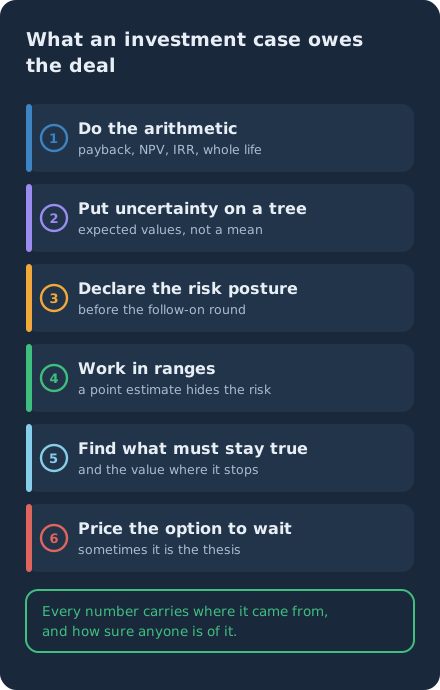
Diligence has a craft, and the good investors already run it. Do the arithmetic of the return properly (payback, net present value, internal rate of return, and the whole-life picture rather than the exit slide) while remembering Meredith and Mantel's long-standing warning that financial selection models flatter whatever they can count. Put the uncertain decisions on a tree with expected values, as Magee set out in 1964, rather than arguing about the mean in a meeting. Declare your risk posture instead of discovering it during the follow-on round: utility theory, after von Neumann and Morgenstern (1944), is what "we are risk averse below this line" actually means. Work in ranges rather than points. Ask what would have to stay true for this to work, and find the value at which it stops being true. Ask whether more evidence is worth buying before you buy it. And price the option to wait, because sometimes it is the whole thesis.
All of that is done by hand, in spreadsheets, by people who are good at it. Which is why the second finding here is worth stating plainly. Independent studies of real spreadsheets found error rates high enough to be a governance problem in their own right: Freeman, "How to make spreadsheets error-proof" (Journal of Accountancy, 1996), and Panko and Halverson, "Spreadsheets on trial: a survey of research on spreadsheet risks" (HICSS-29, 1996), which synthesises the field, large spreadsheets very frequently contain at least one material formula error, and the people using them are confident anyway.
There is a second gap, one step earlier in the chain, and this part we have seen ourselves. Much of what an investor models is not their own work at all: it arrives from a fund administrator or a portfolio company as a finished pack. Those packs are frequently nobody's job to check. The failures we have watched recur are mundane and entirely findable, totals that do not foot, a balance sheet that does not bridge to the capital statement, a narrative note carried forward with its date rolled on a year, a fee rule applied against the wrong base. None of it needs sophisticated analysis to catch; it needs somebody to look, before the numbers are read rather than after. The cost of not looking is rarely a wrong decision. It is a cycle of corrections, and the drag that puts on the people doing the work.
That is third-party research about spreadsheets and our own observation about the packs investors are handed; we have no measured comparison of our own to offer and would not invent one. Read it as the case for models whose numbers carry their provenance and their confidence into every calculation that touches them: the expensive part of a diligence model was never the drawing, it was building it and keeping it true.
Read moreThe same engine as Just Good Business
SOSX Investment runs on the same platform as Just Good Business, pointed the other way down the table: the business at the centre, its whole operating ecosystem built out around it from the data room and cited research, with every claim citing a catalogued source, uncertainty carried on every value, and the reasoning inspectable rather than taken on trust. What it surfaces is prospects, the strength of the moat, and exposure to disruption and dependencies, for a human judgement it does not replace.
Read moreThe question behind the question
What does this business's ecosystem actually depend on, and which of those dependencies would we only discover in month three of diligence? That is the question SOSX Investment answers from the data room in: the supply chain nobody mapped, the regulatory exposure two hops away, the rival or supplier whose next move would test the moat. After you invest, the same model stays live, and scheduled agents watch those dependencies for you, so a change reaches you as it happens rather than at the next quarterly pack.
Free to download
Go deeper
Bring us a live thesis
If you would rather test it than read about it: bring us a data room, or a sector you know cold, and see whether the ecosystem view tells you anything you didn't already know. If it doesn't, that is a useful answer too.
Send us your question and let's have a chat.