
About SOSX
The reasoning is the asset
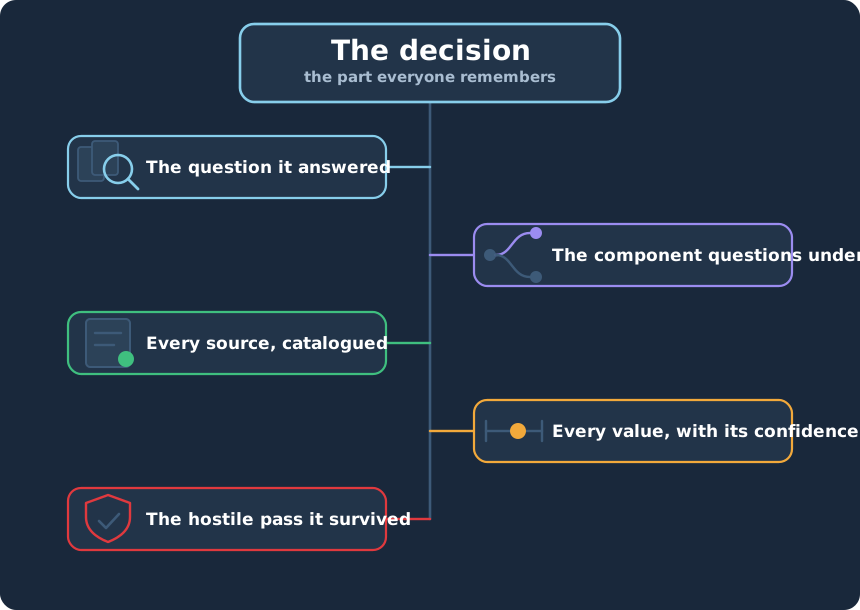
Everything underneath the decision, kept
The question, the component questions, every source, every value with its confidence, and the hostile pass it survived.
Read moreWhy SOSX is built this way
Every serious decision leaves two things behind: the choice, and the reasoning that produced it. Most tools keep the first and lose the second. SOSX® is built on the opposite conviction: that the reasoning is the asset. A decision nobody can walk back through is one you cannot defend when it is challenged, cannot revisit when the world moves, and cannot learn from when it turns out wrong.
So the platform is a reasoning layer first and a map second. You bring one broad question. SOSX decomposes it into the component questions it actually depends on, researches each with a team of specialised agents, and builds the answer into a connected model of the problem space, systems, actors and the typed connections between them, where every connection says what it carries.
What that changes is the part nobody enjoys. Every value carries its provenance and its confidence, so a reader always knows which statements are judgement and which are proof. Every claim cites a catalogued source by stable ID. The model is attacked before you take it anywhere, because a conclusion that has not survived a hostile pass is a conclusion you are carrying on trust. And when the world moves, you re-run it rather than rebuild it.
None of this is a substitute for your judgement. The human stays in the chair: SOSX does the expensive, patient work underneath a good decision and hands you something you can interrogate, not a verdict you have to believe.
Live enterprise trials
with a large global aerospace manufacturer
50+
specialised AI agents research, map and analyse your problem space
33
import and export formats, nine MBSE tools among them
478
built-in unit conversions
Built by Digital Tactics: a 15-year UK SME with more than 170 client projects, Cyber Essentials certification and AWS partner status.
The discipline is older than the software
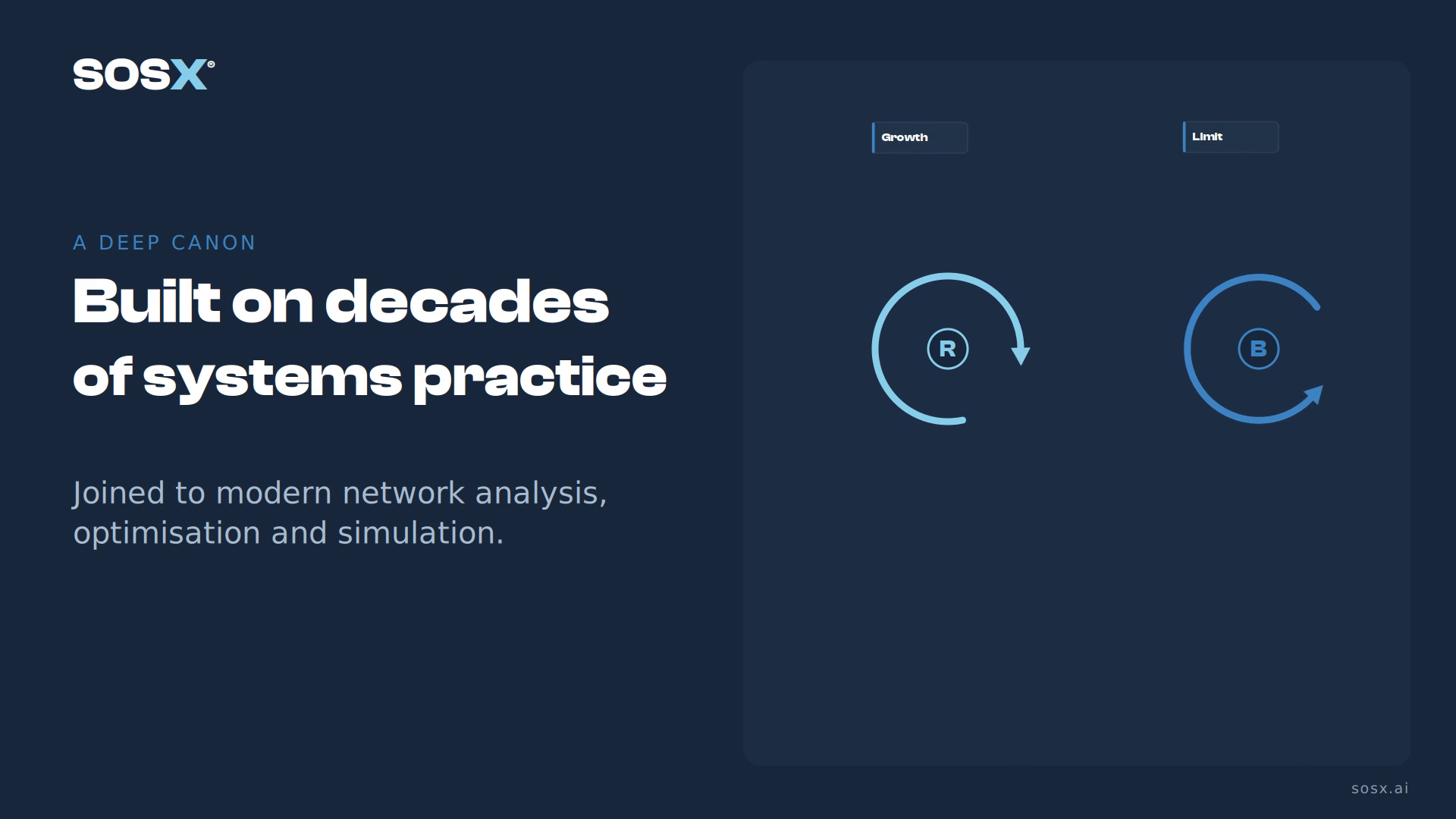
SOSX stands on a deep canon: decades of systems-analysis method, joined to modern network analysis, optimisation and simulation.
Read moreThe canon behind SOSX, from 1948 to now
SOSX stands on a deep canon. Rigorous systems analysis is a documented practice with decades of method behind it, and we have built on that rather than around it: well-understood modelling technique, joined to modern network analysis, optimisation and simulation. Every part of the practice can still be done by hand, with a whiteboard, a reading list, a spreadsheet and a couple of good arguments. The platform automates the expensive parts and keeps the discipline honest; it does not replace it.
The methods are not standing still either. As a Business, Industry and Government partner of the KE Hub for the Mathematical Sciences, we put our open problems to university mathematicians: higher-dimensional network modelling for emergent behaviour and clustering, flow models for parameters that move stickily rather than cleanly, and graph-optimisation methods beyond the Bayesian and Monte Carlo modes we run today. Those are open questions rather than shipped features, and asking them properly is how the analysis gets sharper.
The canon is worth knowing in its own right, and it is what the platform is built on, so here it is.
1948
Feedback becomes a science
Norbert Wiener, Cybernetics
Control and communication in animal and machine: the loop enters engineering, and never leaves.
1961
Structure produces behaviour
Jay Forrester, Industrial Dynamics
Stocks, flows and delays explain the swings no spreadsheet predicts, system dynamics is born.
1974
Judgement fails predictably
Tversky & Kahneman, Science
Anchoring, availability, representativeness: why unaided intuition needs written discipline.
1985
Futures worth arguing with
Pierre Wack, Harvard Business Review
Scenario planning, from the practice that established it: you cannot forecast the future, but you can be ready for three of them.
1986
Innovation is a whole-system problem
Andrew Van de Ven, Management Science
Managing whole systems named among the central problems of innovation management.
1990
The organisation that learns
Peter Senge, The Fifth Discipline
Systems thinking becomes organisational practice: loops, archetypes and shared models at company scale.
2008
The craft, written down
Donella Meadows, Thinking in Systems
Boundaries, stocks, loops and leverage points as a learnable craft: the discipline's most humane textbook.
2024
The discipline becomes certifiable
ISO 56001
Innovation management gets its first certifiable international standard, with a systems approach named among its principles, and the method left to you.
Today
The discipline, operationalised
SOSX
More than fifty specialised AI agents carry the labour (the research, the mapping, the evidence-chasing) and you keep the judgement. That is the whole idea.

Read moreWhere SOSX came from
SOSX was built for Innovate UK's Agentic AI Pioneers competition, and it is in live enterprise MBSE trials with a large global aerospace manufacturer.
It is built by Digital Tactics Ltd, an AI transformation, software engineering and innovation consultancy: a 15-year UK SME (founded 2011, Hove) that has delivered more than 170 client projects and maintains a portfolio of nine products, of which SOSX is the most important. The claims we make about ourselves are the checkable kind: Digital Tactics holds Cyber Essentials certification and is an AWS partner.
Read moreThe founder
Chris Dean is the founder and CEO of Digital Tactics. Alongside running the company he spent a decade, on contract, as Head of Technology at Endemol Shine UK, the British arm of one of the world's largest independent television production groups, where his teams ran national-scale live interactive systems with hundreds of thousands of concurrent viewers. He read chemistry (MChem) at the University of Sussex and undertook postgraduate research at the University of Southampton's Optoelectronics Research Centre. He describes himself as a frustrated scientist, innovator and creative technologist.
His commercial work is anchored in research: the €13 million ITEA GreenCode programme, which he initiated and leads, the ITEA GIGI project, GLEAM and other private industrial research and development programmes. He is a Technology Expert to the European Commission and an Independent Application Assessor for Innovate UK.
Read moreResearch
A paper on the SOSX design has been submitted to a peer-reviewed journal. Submission is not acceptance, and we claim nothing more until the review process has run its course, but the discipline behind the manuscript is worth stating, because it is the platform's own discipline applied to ourselves: every reference verified against publisher records before submission, scoping searches documented, and an adversarial review run before anything left the building.
The same discipline produced the SOSX book series, eight books that teach rigorous systems practice first and describe the platform second, and it anchors the academic framing of the platform itself: research support is one of SOSX's nine domain framings, built around protocol-driven literature search, credibility-tiered sources and a citation gate that drops any machine-emitted reference not backed by a retrieved source.
Bring us a real question
The fastest way to judge SOSX is on your own problem, not on ours.
Send us your question and let's have a chat.