

SOSX Engineering
Systems of systems, mapped and analysed.
SOSX Engineering supports the concept design phase of MBSE: the system of systems a programme depends on, mapped, sourced and traded before any design is frozen, in live enterprise trials with a large global aerospace manufacturer.
The problems it solves
- “The decisions that commit most of the cost are made at concept stage, before a model exists to check them.”
- “The programme depends on suppliers, infrastructure and rules that nobody on it controls.”
- “Our requirement values trace back to a workshop photograph, not the evidence that set them.”
- “Detailed design starts from a slide deck.”
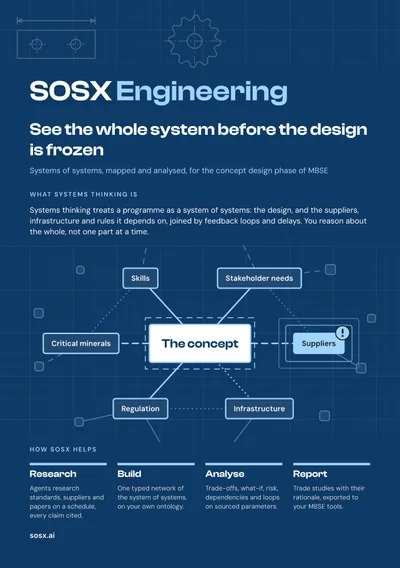
SOSX Engineering: See the whole system before the design is frozen
See SOSX Engineering at work
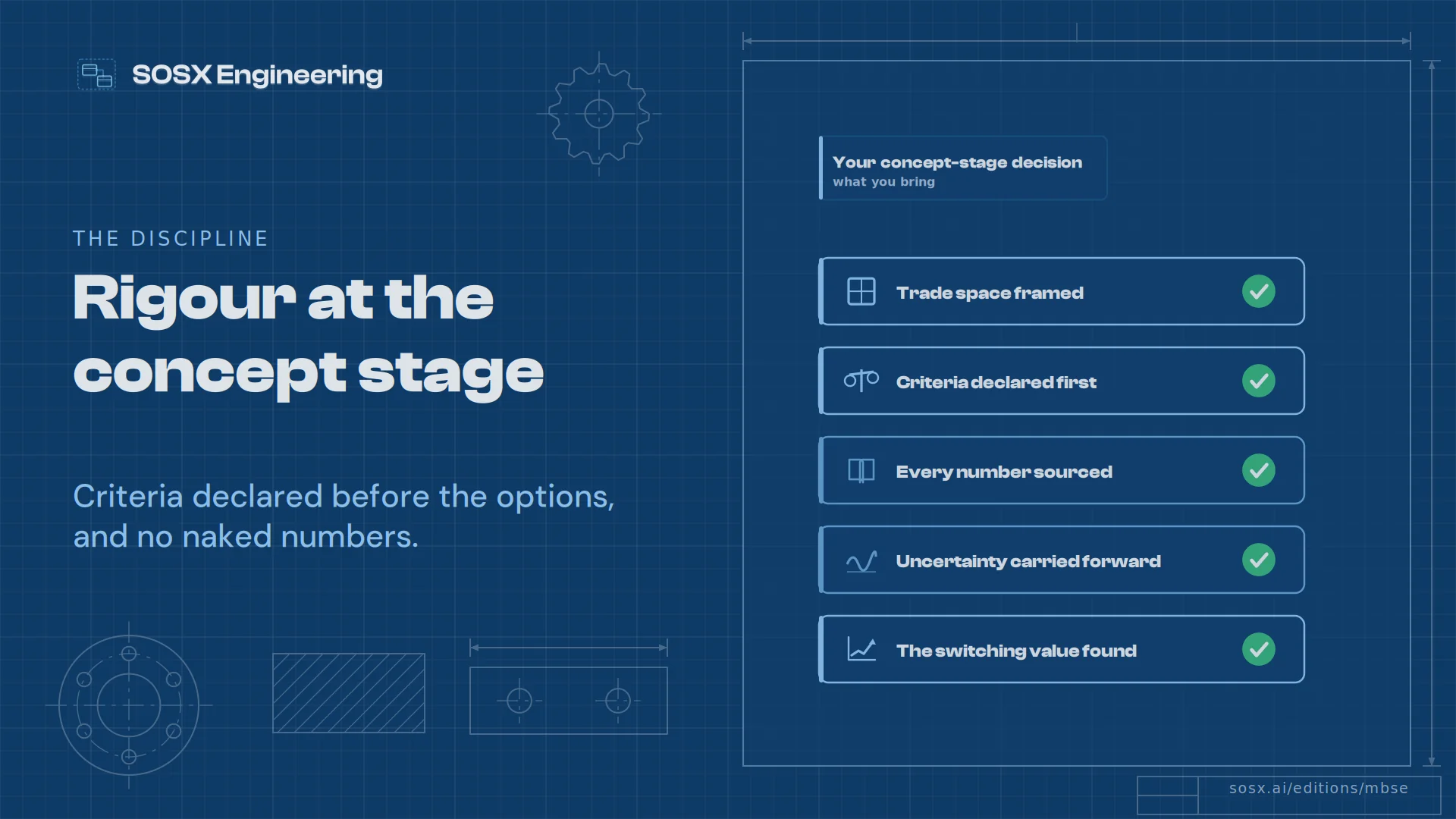
The practice the platform serves, before anything is automated. 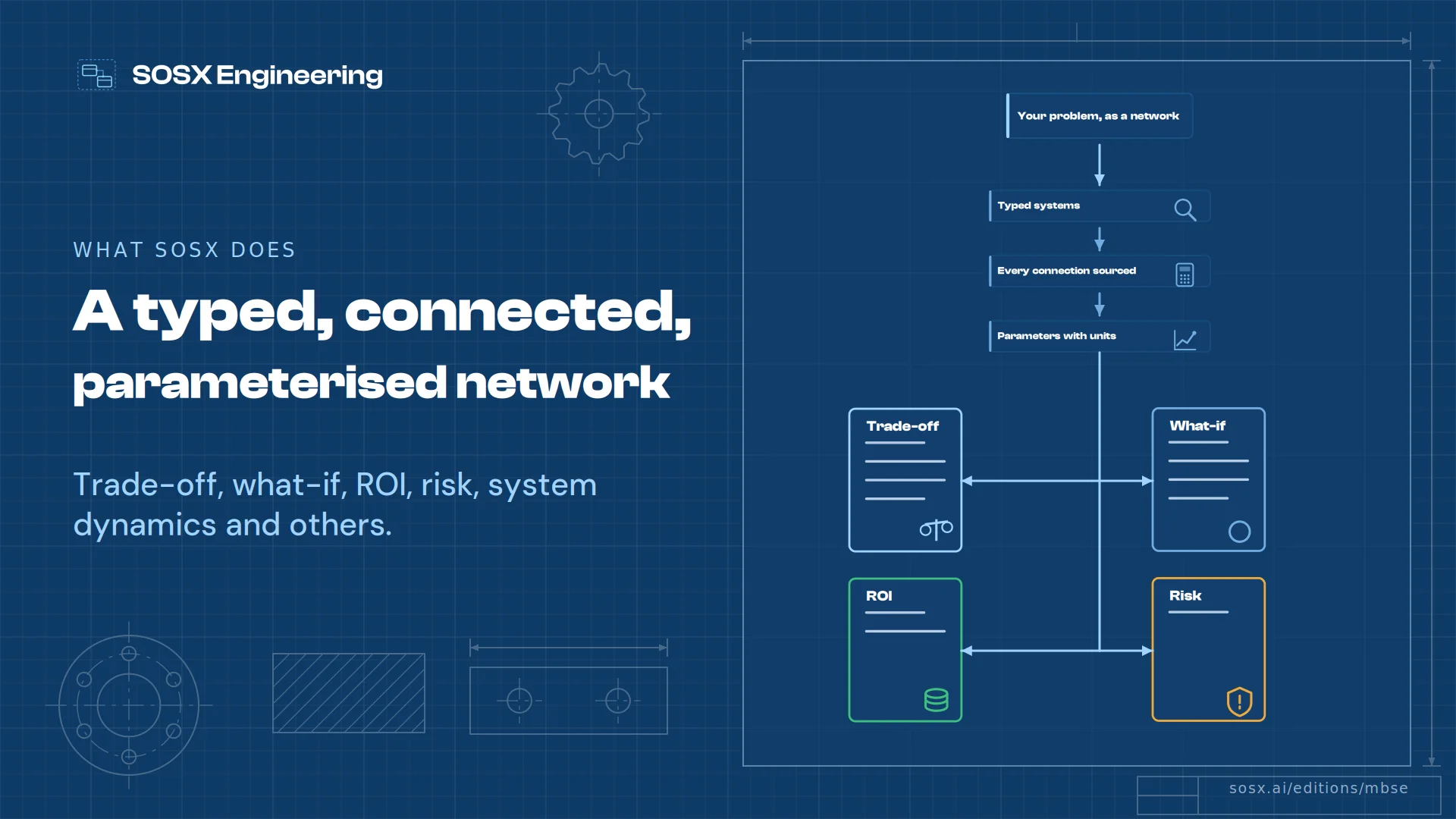
The problem built as a typed, sourced network, then analysed. 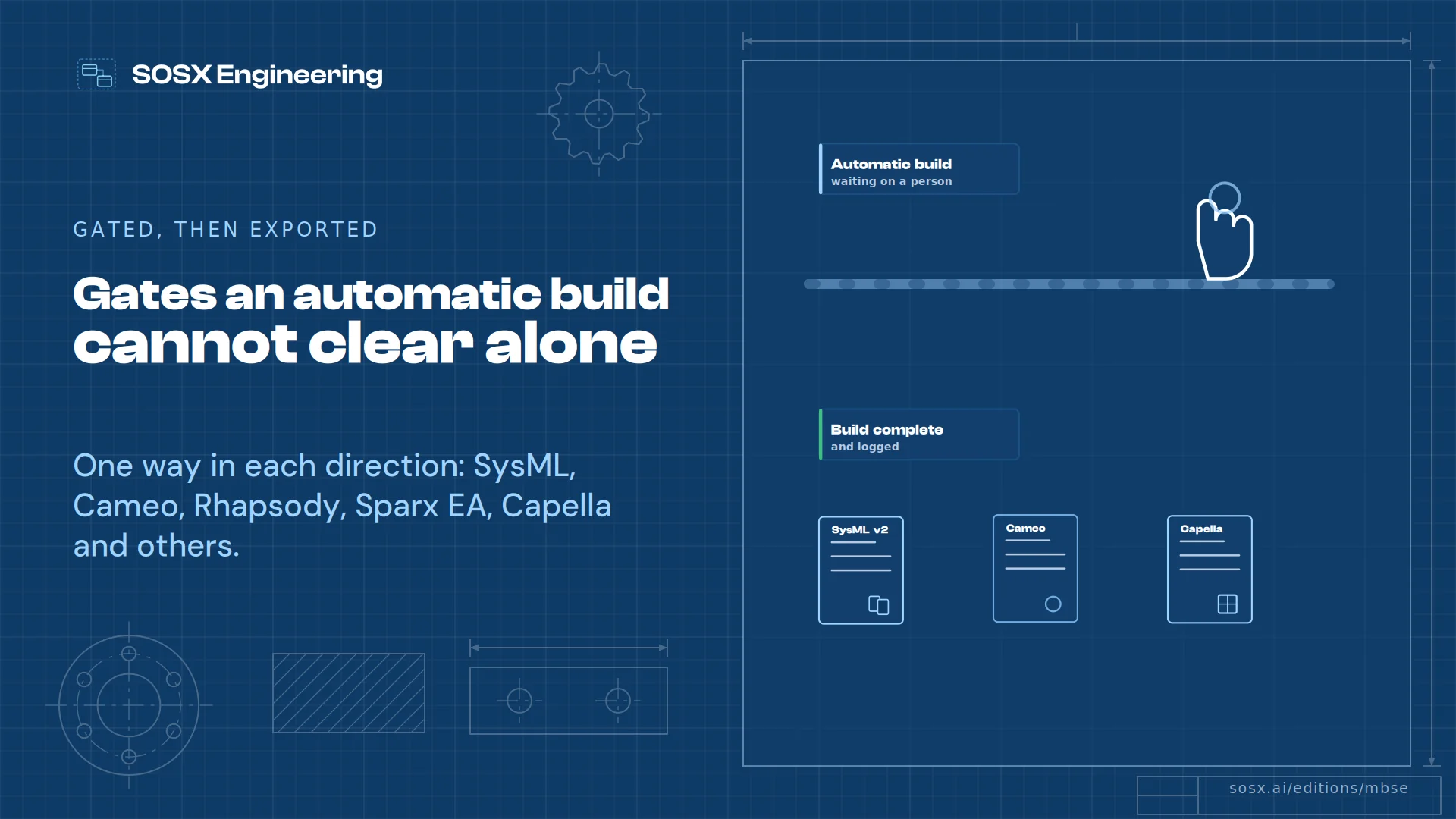
Review gates an automatic build cannot clear alone, then export to the MBSE tools you run. 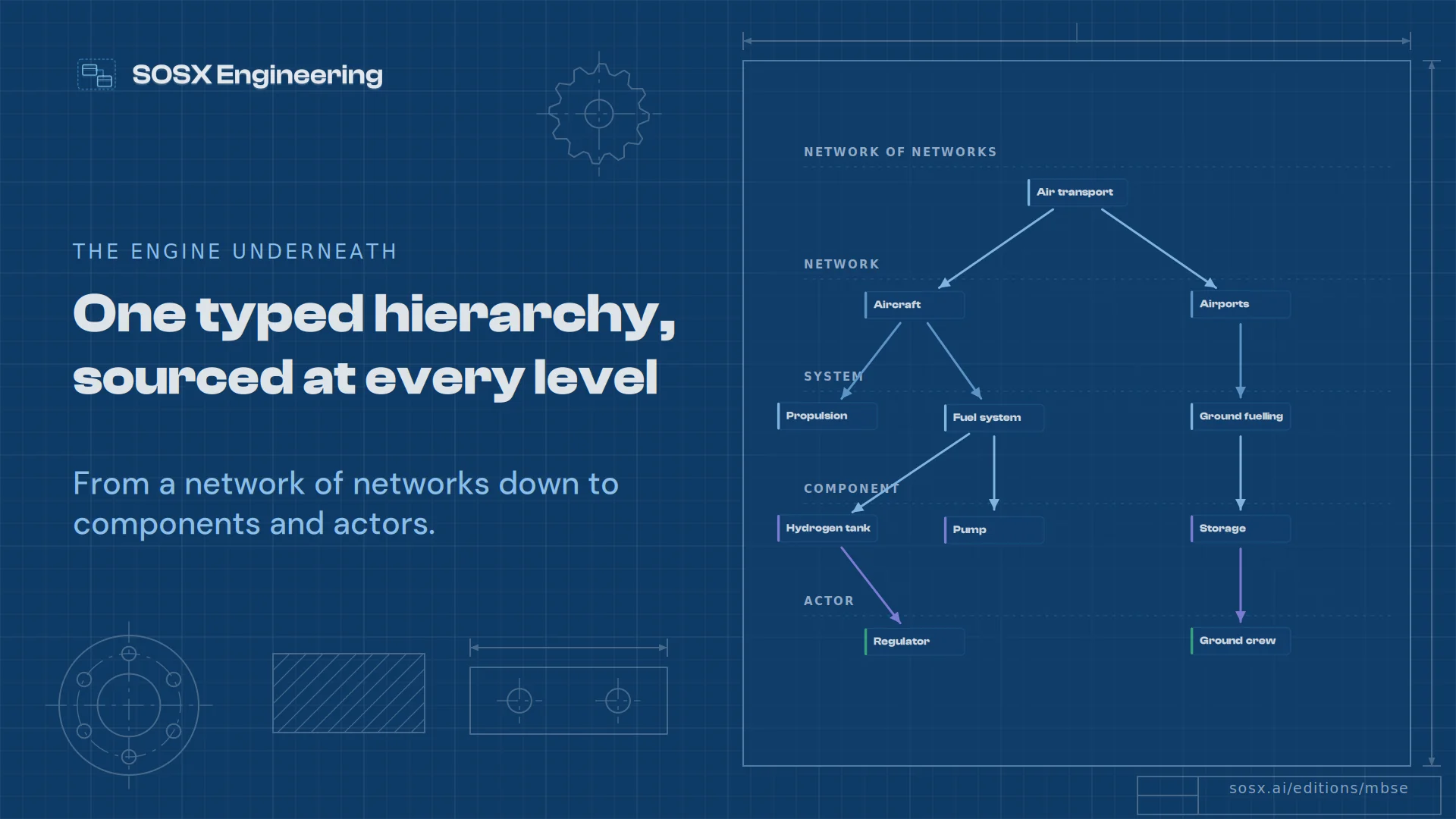
One typed hierarchy, from a network of networks down to components and actors. 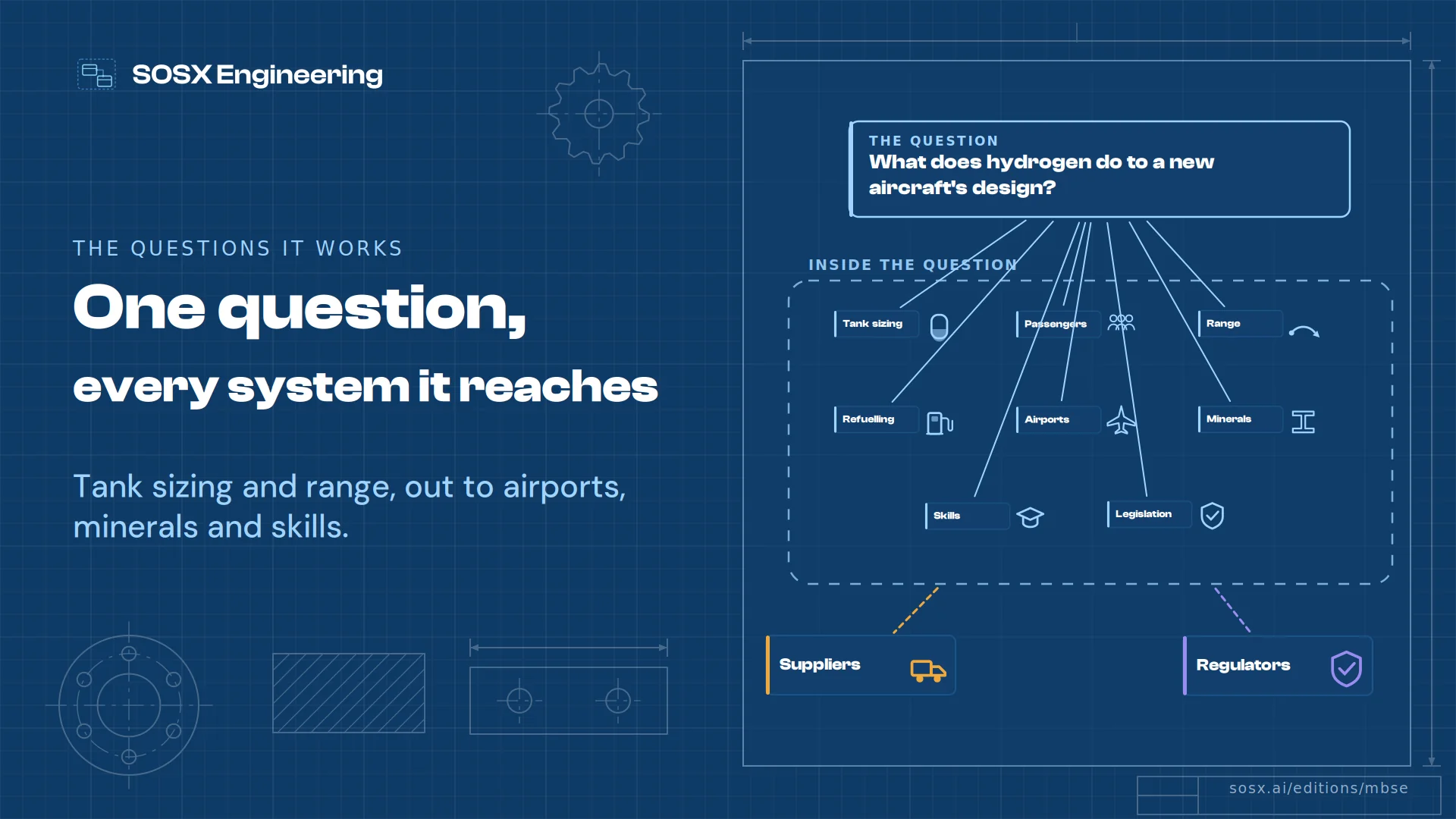
The hydrogen question, decomposed into the systems it reaches. 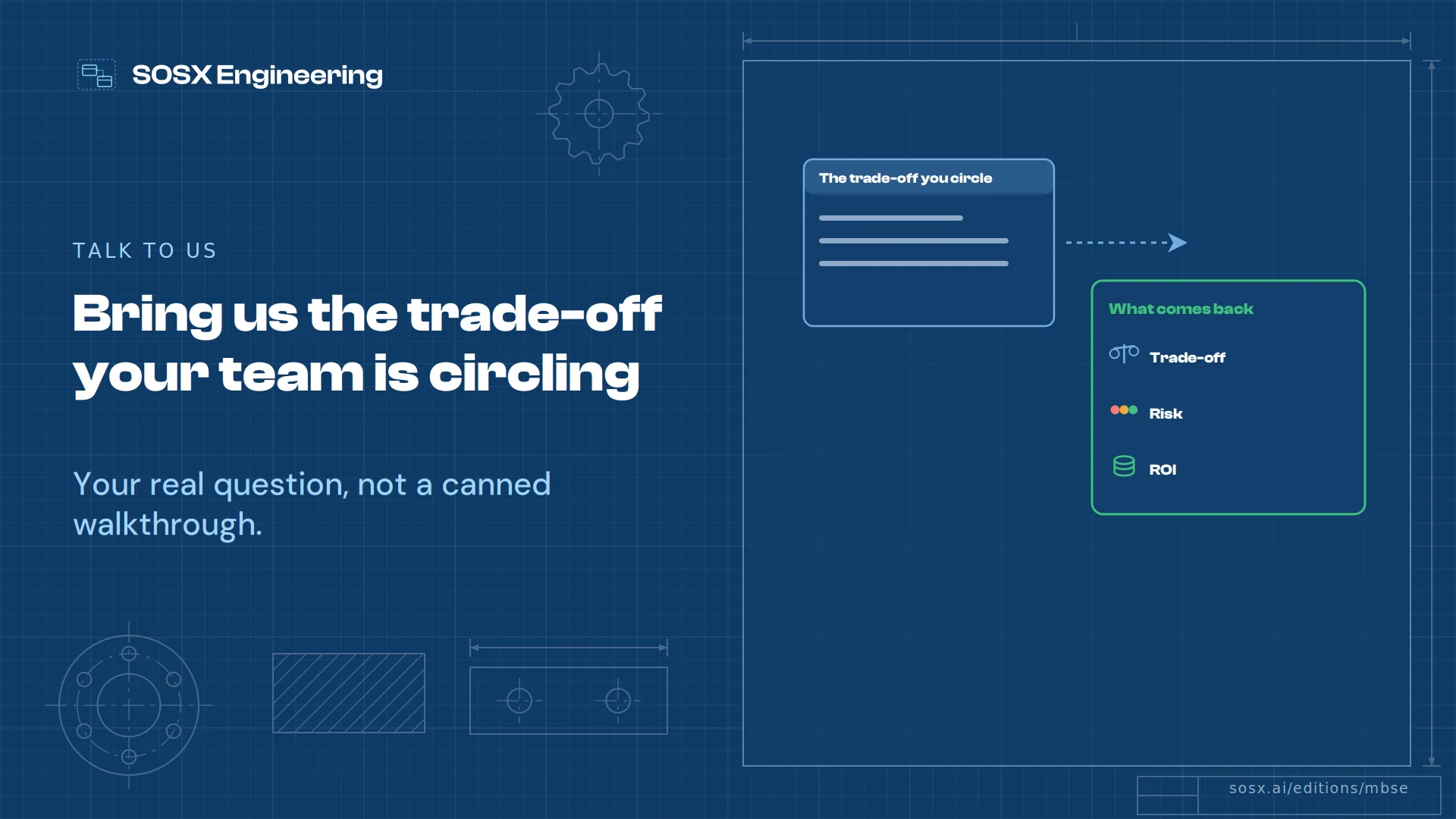
Bring a real trade-off, and see what comes back.

How SOSX helps
Research
Specialised agents research the question, every claim citing a source.
Build
One typed, connected network, every value with its units and confidence.
Analyse
What-if, feedback loops, dependencies, trade-offs, risk and ROI.
Report
SWOTs, risk registers and decision reports, red-teamed before you see them.
The detail
For when you want the whole argument.
Read moreWhat SOSX Engineering does
SOSX Engineering supports the concept design phase of MBSE. SOSX began here: systems-of-systems mapping and analysis at the concept design stage of model-based systems engineering, the stage where the decisions that commit most of a programme's cost are taken before the detailed model exists to check them. SOSX Engineering is in live enterprise trials with a large global aerospace manufacturer: trials, not production, and we make that distinction because it is exactly the one you would make evaluating us.
This is where the platform began, and where it earns its keep today. Before the capability, though, the practice it serves.
Read moreThe discipline: what concept-stage rigour asks of you
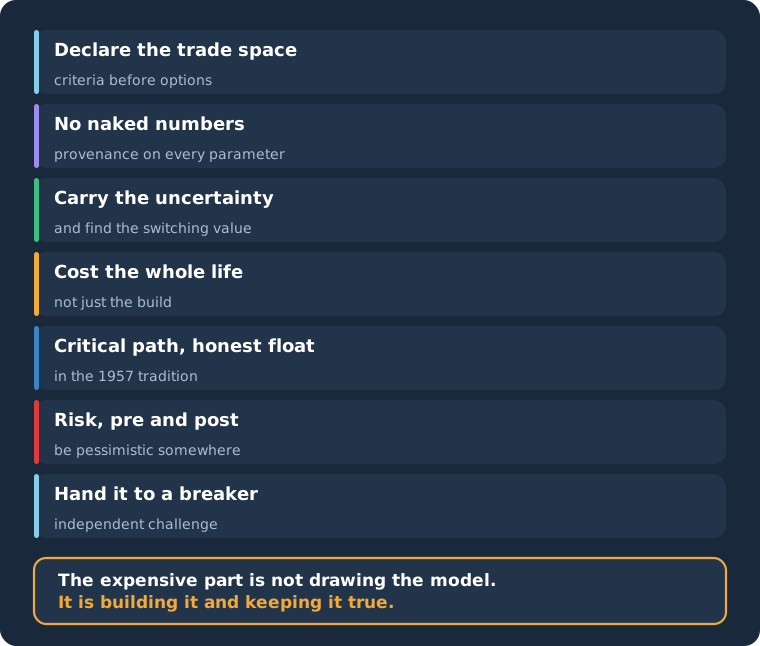
Concept design has a practice of its own, and it is a demanding one. Frame the trade space, then run trade studies and analyses of alternatives against criteria declared in advance rather than around the option someone already prefers. Parameterise with provenance: no naked numbers. Carry uncertainty forward instead of collapsing it to a single point (sample it where you can, as Monte Carlo methods have done since Metropolis and Ulam (1949)) and find the switching value, the parameter at which the recommendation flips. Cost the whole life, not the build. Schedule the work with a critical path and honest float, in the tradition Kelley and Walker set out in 1957. Keep a risk register with pre- and post-mitigation severity, and be systematically pessimistic somewhere: FMEA, or a fault tree. Then hand the whole argument to somebody whose job is to break it.
None of that needs us, and the good teams have been doing it by hand for fifty years. What it costs is the part nobody budgets for: sourcing every number, keeping the units straight, holding the boundary you declared, and re-running the argument when a supplier moves. The expensive part is not drawing the model: it is building it and keeping it true. That is the part the platform is pointed at.
The methods in that list which SOSX does not run for you stay yours to run; what it gives them is a model whose numbers carry their sources, their units and their confidence, so they are worth running at all. The companion book, The Concept Design Advantage, teaches the practice in full, by hand, with the machine kept in its place at the end.
Read moreWhat SOSX does about it
The capability, plainly:
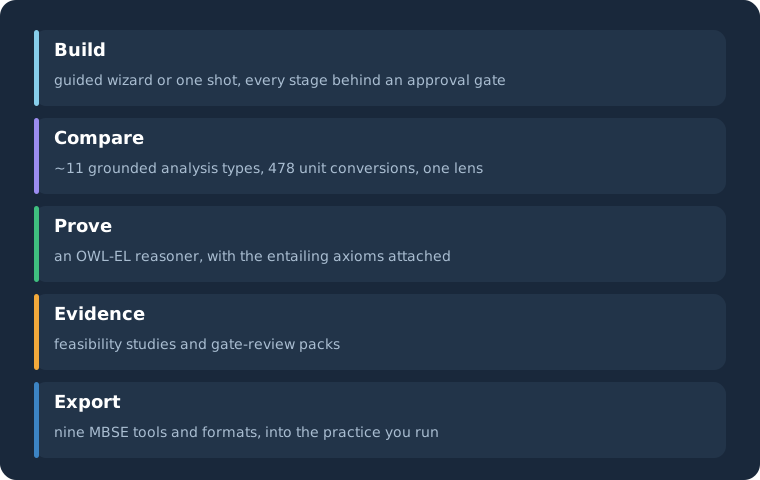
- A six-stage guided build wizard and a one-shot auto-build. Either way, the problem becomes a typed, connected, parameterised network, and every build stage produces a reviewable artefact, the stages that decide the model sit behind a human approval gate, and an automatic build stops at review gates it cannot clear on its own.
- ~11 grounded analysis types (trade-off, what-if, ROI, risk, system dynamics and more), with 478 built-in unit conversions across 13 dimensions, so unlike things become comparable through one lens.
- An OWL-EL symbolic reasoner that derives structural facts with the entailing axioms attached, kept visibly separate from LLM judgement and from computation, provable, not just plausible.
- Feasibility-study and gate-review evidence-pack generation, on a platform built against the frameworks an enterprise review tests against.
- SOSX exports into nine MBSE tools and formats (SysML v2, Cameo, Rhapsody, Sparx EA, Capella, Modelio, MATLAB/Simulink, ArchiMate, draw.io), and imports from the same nine, one way in each direction: outputs land in the MBSE practice you already run, not in another silo.
Read moreThe engine underneath
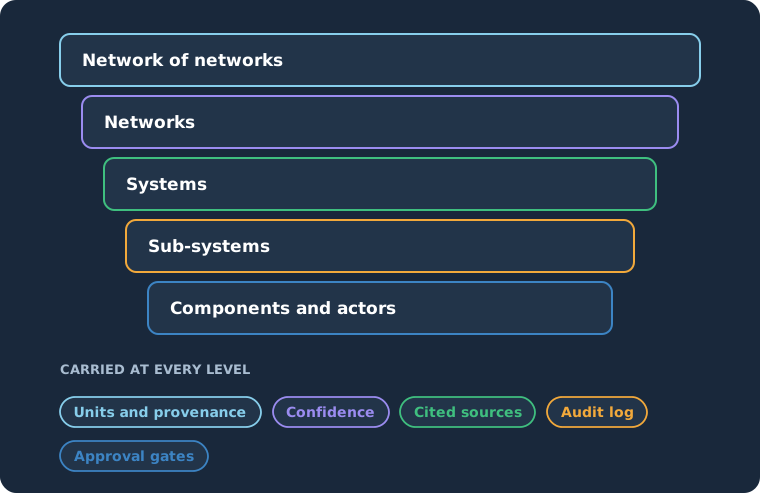
SOSX Engineering is one of eight products powered by the same core engine, the one where that engine has reached trial-release maturity. The platform it runs on is what every other product inherits: a typed hierarchical network model across the full layered hierarchy, from network of networks down to components and actors; unit-aware parameter ports carrying provenance and confidence markers; grounded, citation-backed analysis in which every claim cites a catalogued source; per-network audit databases logging every LLM interaction; human approval gates on the stages that decide the model, and review gates an automatic build cannot clear on its own; and toolchain export, so outputs land where teams already work.
Read moreThe questions it works
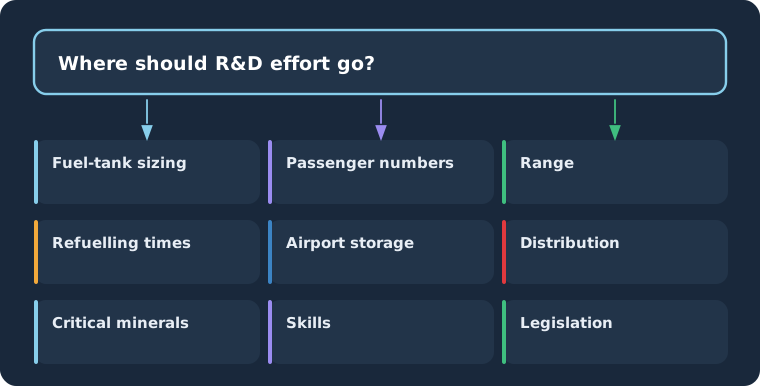
A large global aerospace manufacturer wants to understand where to spend R&D effort when designing new planes. The questions are an engineer's questions, not a feature list: what does hydrogen's energy density do to fuel-tank sizing, to passenger numbers, to range, to refuelling times? What about hydrogen storage at airports, critical-mineral supply risk, skills, legislation?
SOSX decomposes the broad question, puts a specialised agentic AI research team on each part, maps everything as a connected network with its reinforcing and balancing flows, parameterises it from cited sources, and runs the analyses. In our experience it can realise weeks and months of work in just a few hours, said qualitatively, because we haven't run the benchmarks and would rather show you than quote numbers at you. The full mechanism, step by step, is on the platform page.
Free to download
Go deeper
Bring us a real concept-design question
We are in live enterprise trials with a large global aerospace manufacturer, and we would rather work one of your real concept-design questions than show you a canned walkthrough. Bring us the trade-off your team is circling, and watch SOSX work it.
Send us your question and let's have a chat.