

Just Good Business
Put your business at the centre. See where it can go.
Just Good Business, powered by SOSX, helps you grow, pivot and reduce risk: a comprehensive assessment of your business as a system of systems, for founders building a go-to-market and owners of established businesses, with evidence you can interrogate.
The problems it solves
- “Which segment first, through which channel, and at what price?”
- “We’re busy. But where is the next pound of profit?”
- “I only find out a big client is drifting when the invoices stop.”
- “Is the shape of the business still winning?”
Just Good Business: Grow, pivot and reduce risk
See Just Good Business at work
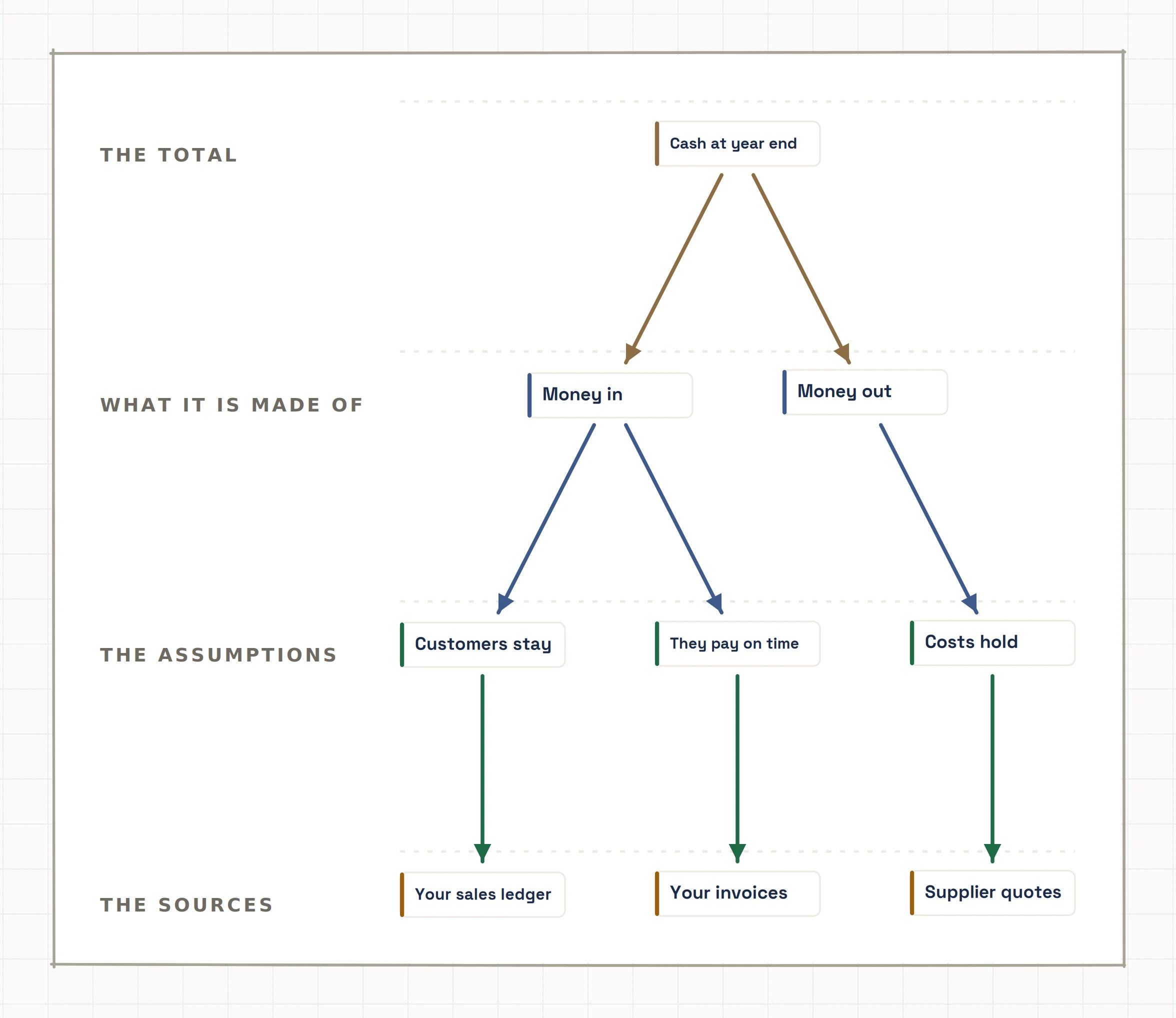
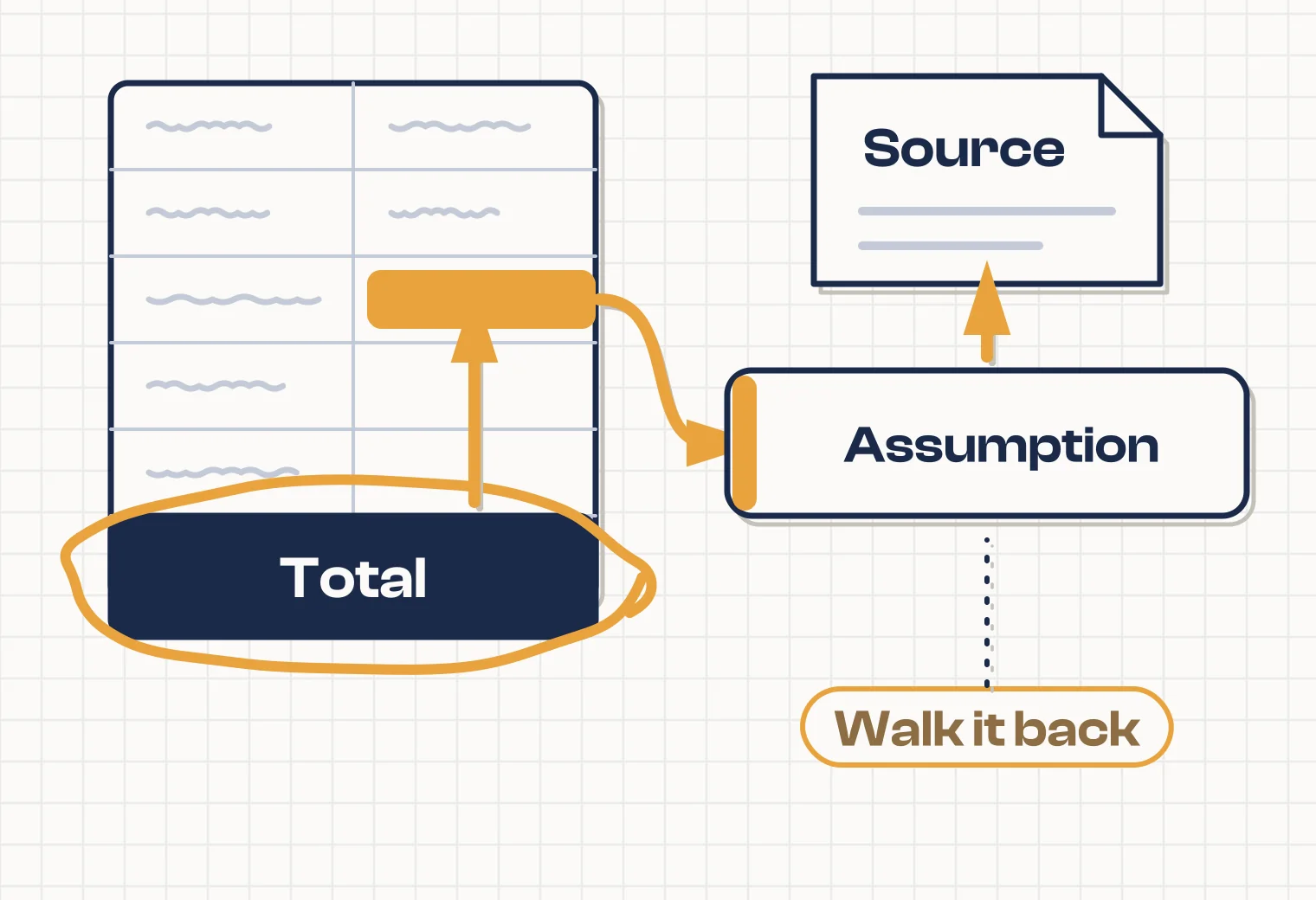
A total walked back to the assumptions underneath it, and to where each came from. 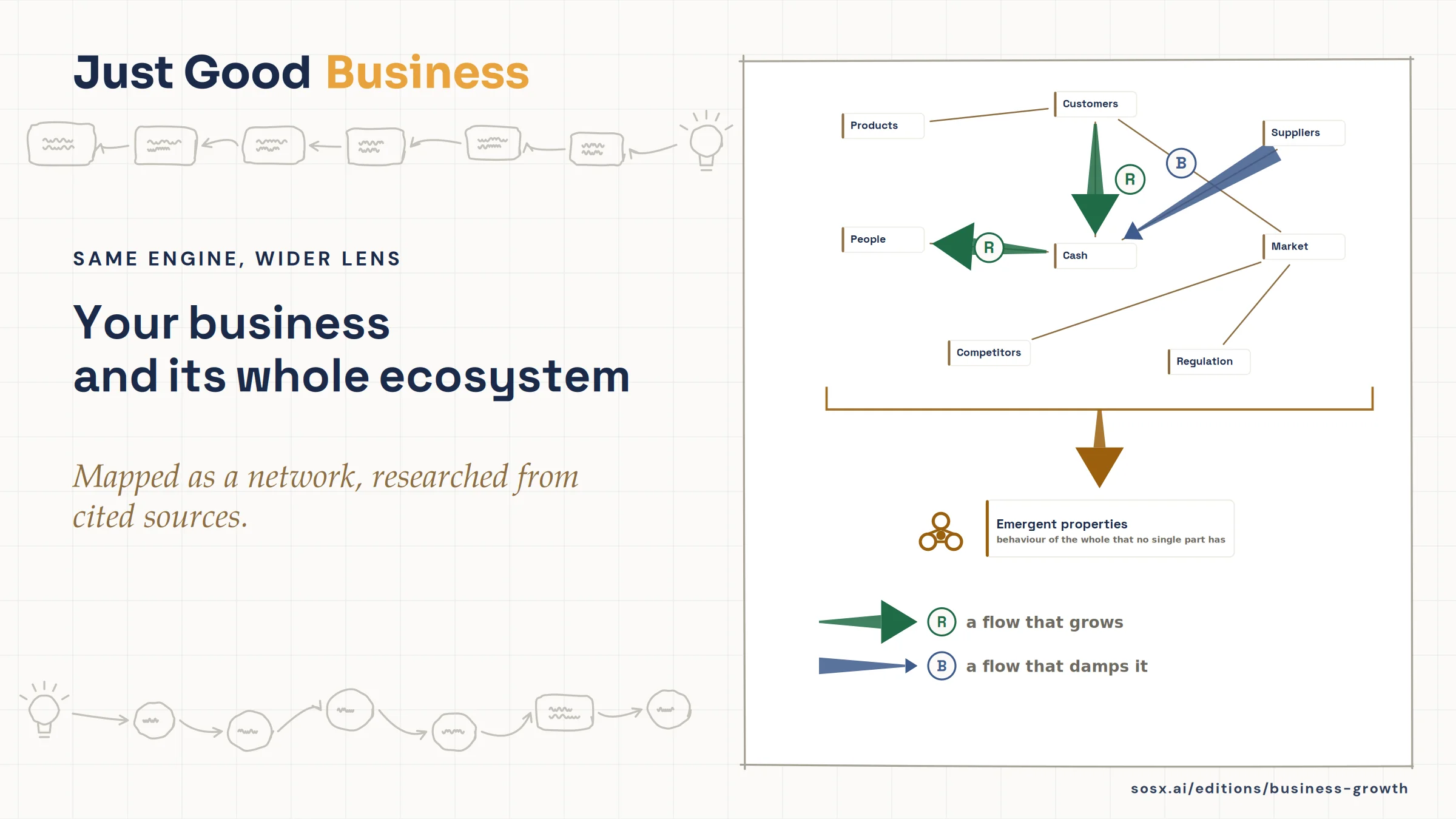
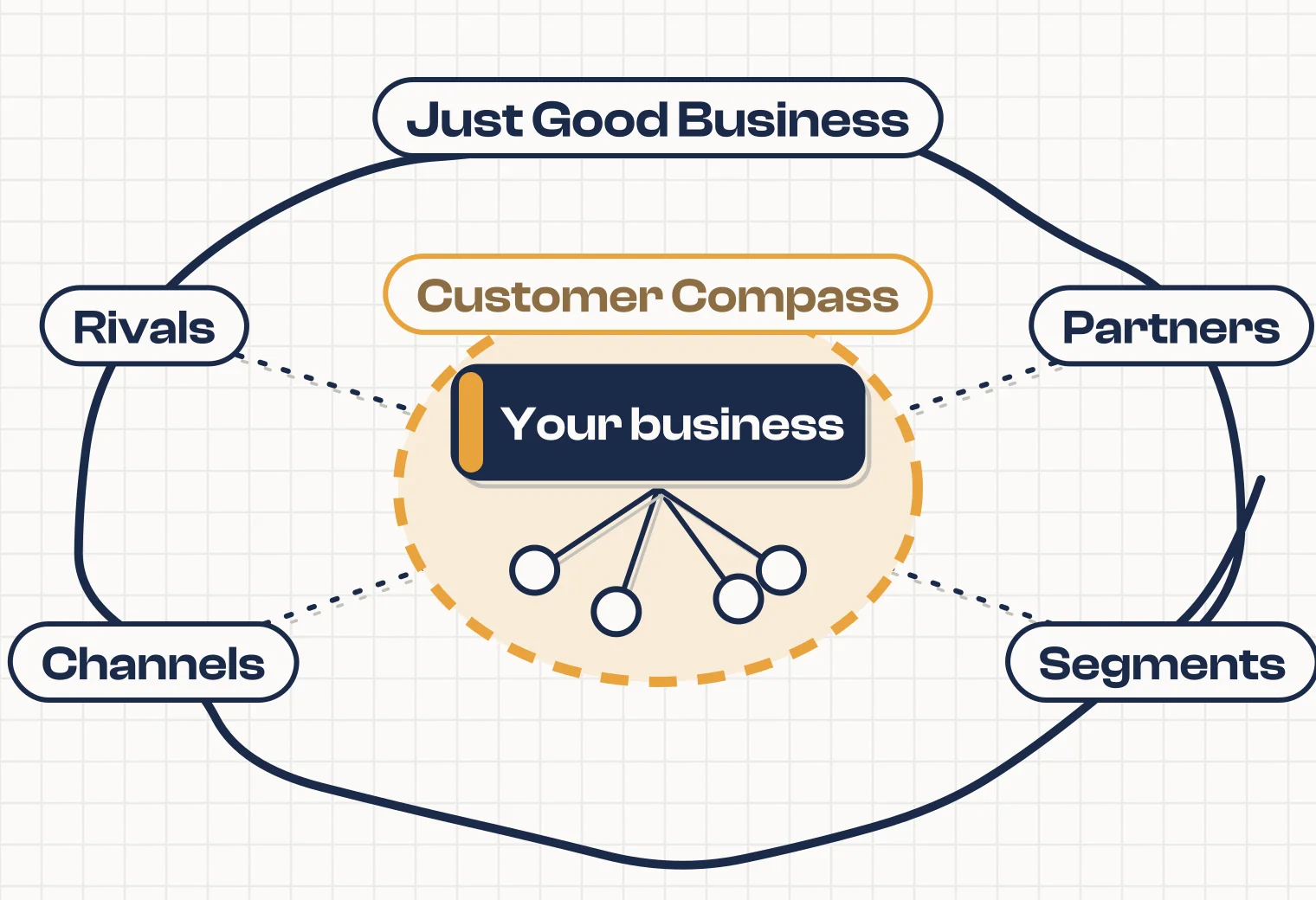
The business mapped as a connected network, with the flows that grow it and the flows that damp it. 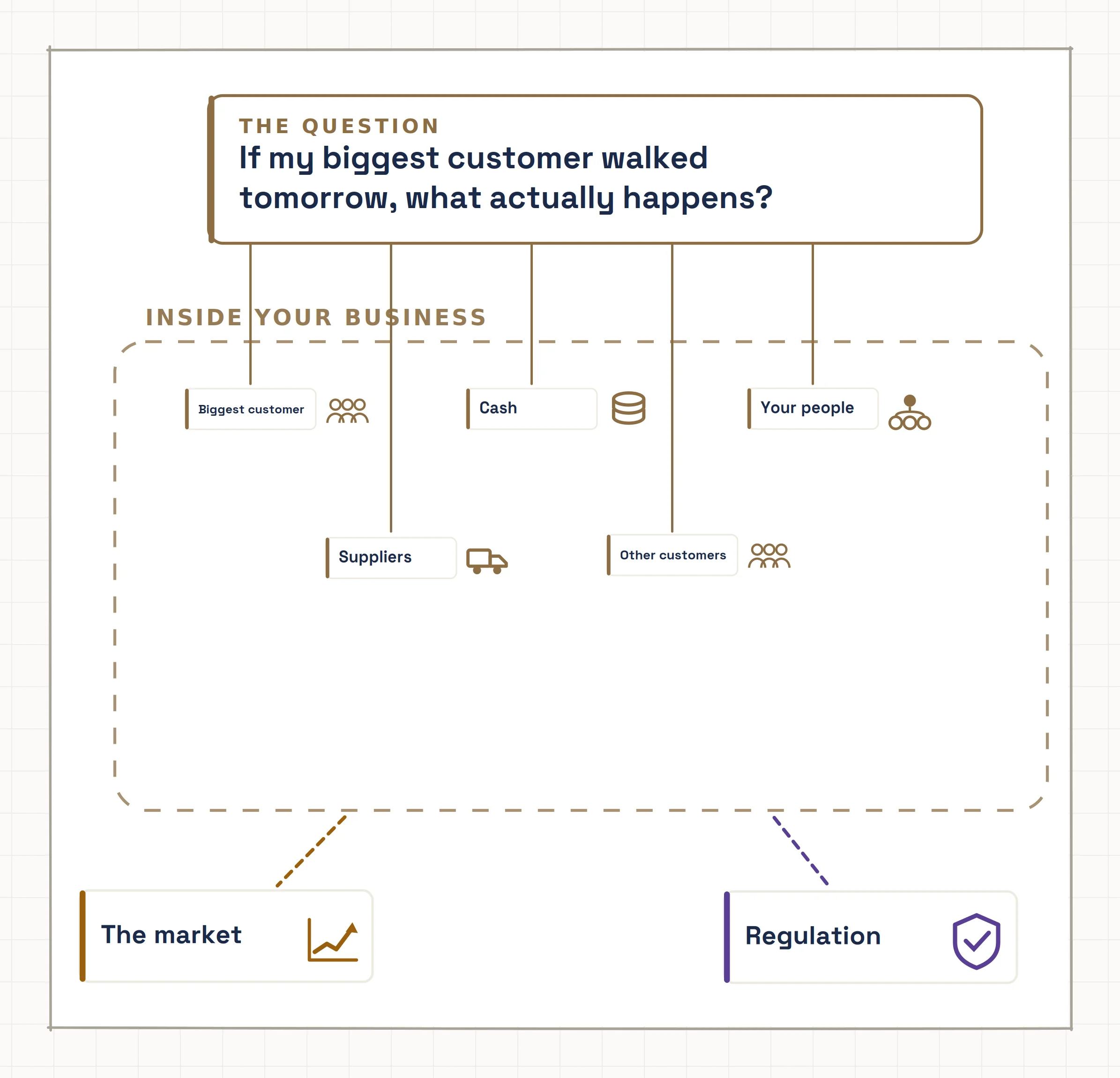
The owner's question, drawn as the network it reaches across. 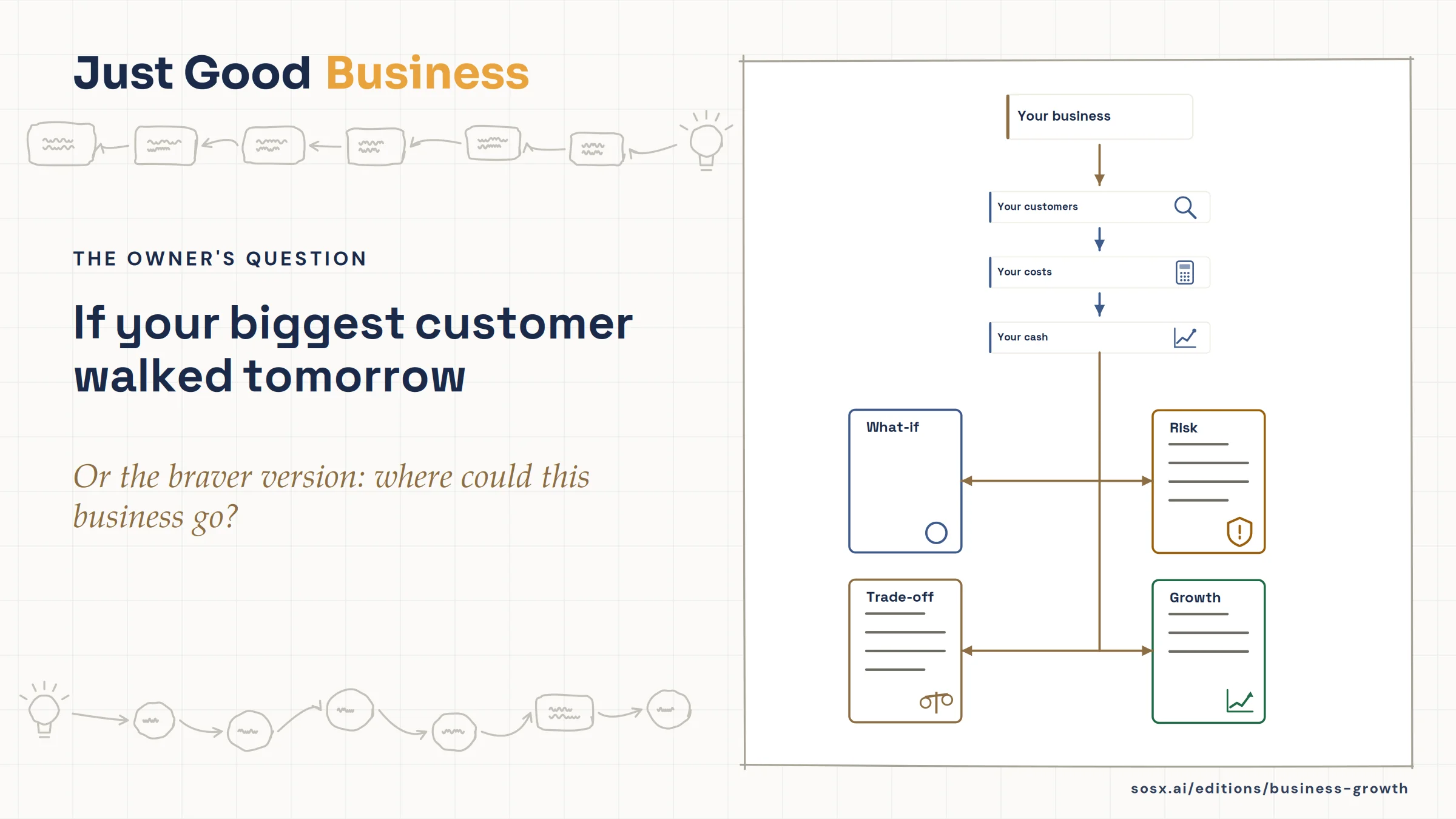
Your own customers, costs and cash, run through what-if, risk, trade-off and growth analyses. 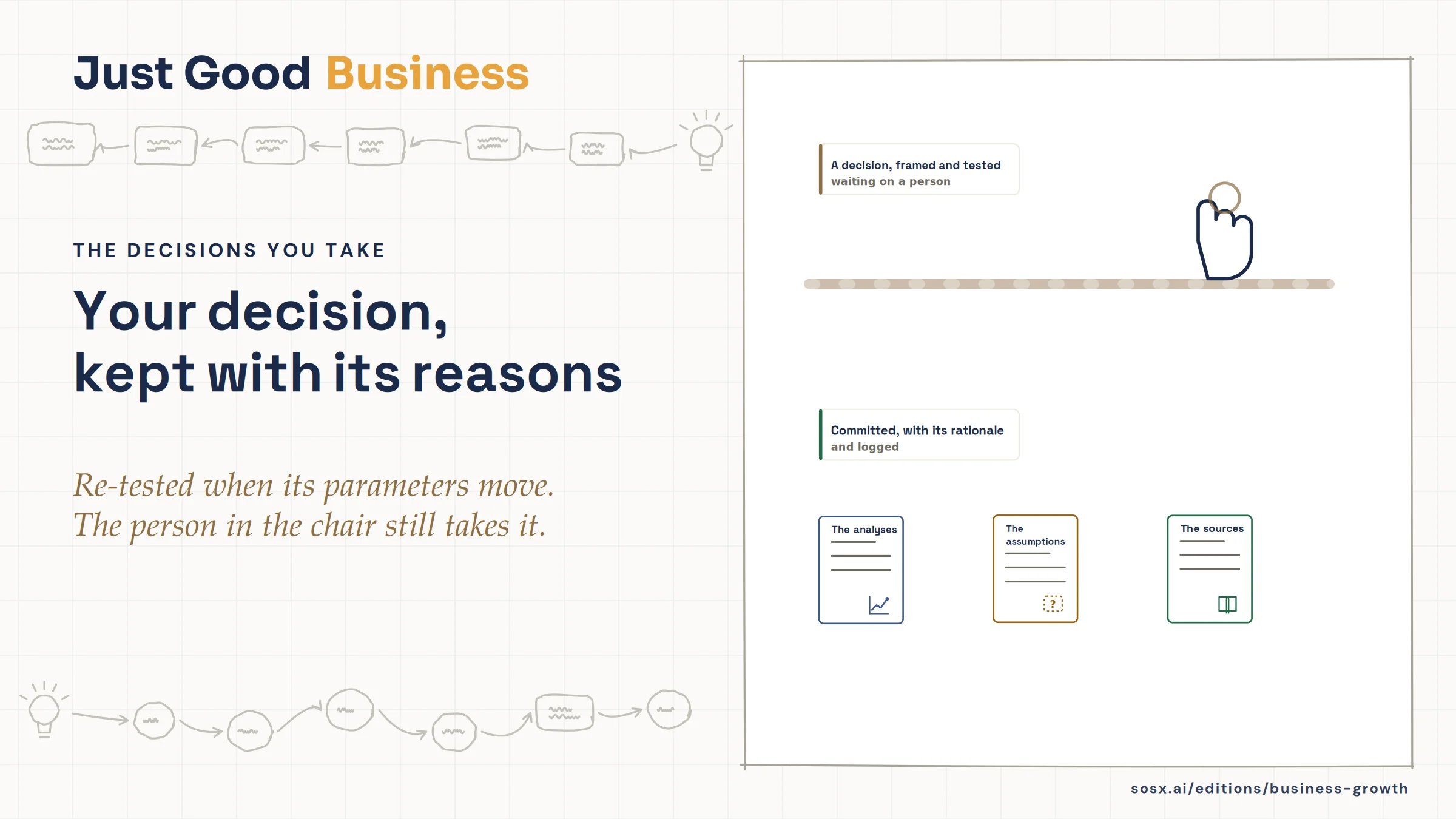
A decision committed by a person, with the analyses, assumptions and sources behind it kept for the re-test.

How SOSX helps
Research
Specialised agents research the question, every claim citing a source.
Build
One typed, connected network, every value with its units and confidence.
Analyse
What-if, feedback loops, dependencies, trade-offs, risk and ROI.
Report
SWOTs, risk registers and decision reports, red-teamed before you see them.
The detail
For when you want the whole argument.
Read moreWhat Just Good Business does
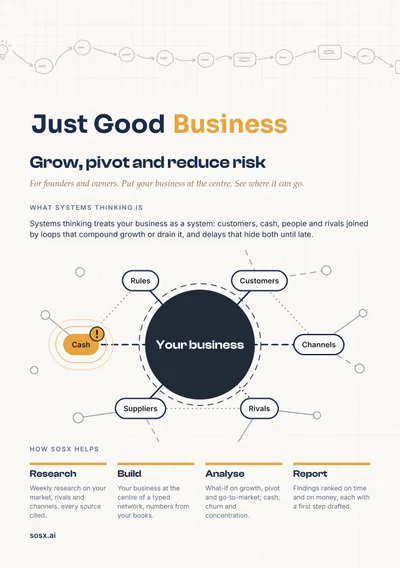
Put your business at the centre. Build out the ecosystem it operates in: customers, suppliers, competitors, channels, regulation. Then use it to grow, pivot and reduce risk. That is Just Good Business, powered by SOSX, and it is delivered as one thing: a comprehensive assessment of your business as a system of systems.
It works from where you are. If you are starting out, it helps you work out your go-to-market: which segment first, which channel, what price and which partners, tested before you spend. If you run an established business, it reads your numbers from your own books, shows where growth and risk sit, and tells you early when the shape of the business needs to change.
The assessment covers every part of the business and the connections drawn between them, not one department at a time. It scores what it finds three ways, and never blends them: the deterministic maths of your stocks and flows, an anchored self-placement, and an audit score, each shown for what it is. Every load-bearing claim carries its evidence grade, so a section is only as confident as its weakest claim and you can see which claim that is. Growth and pivot options are ranked on both of the objectives that matter, time and money, with both always shown. And every finding lands as an action with an owner and a date, because an assessment that ends in observations is a report, and this is a plan.
The assessment is bought at justgoodbusiness.co.uk, where you put your question in your own words. The companion book, Just Good Business, teaches the whole method by hand: the book is the method, the service runs it for you, with the hours of attention it takes done by machine.
Underneath it are the principles proven in Customer Compass, our cash-flow product. The maths is deterministic. The AI narrates but never invents numbers. Every insight comes with a drafted first action. You approve every step. Honesty guardrails as code, not as a promise.
Customer Compass's own features come with it. Your Xero data fills the numbers, with no re-keying. Every client lands in Keep, Grow, Renegotiate or Review. The top-client stress test, the cash forecast, silent churn, price ceilings and revenue at risk all feed the wider map, and each week the moves worth making arrive ranked by what they are worth, each with its first step drafted for you to approve.
The proof point, exactly as it stands: Winner — Cash Flow Accelerator category, Xero Rise of the Builder Hackathon 2026. Judged by Xero. Customer Compass is live in the UK since July 2026; its Xero App Marketplace status is "submitted".
Read moreThe discipline: the numbers work most owners never get taught
There is a management-accounting practice behind good business decisions, and it long predates any of this. Know your contribution per job and your break-even, so you can tell the difference between busy and profitable. Trace overhead to the work that actually causes it rather than smearing it across everything. Plan with a budget you then read the variance against, because the gap between plan and actual is the only feedback loop most small businesses have. Forecast with a stated margin of error rather than a confident single line. Look at performance across every area the business depends on, Drucker's list still holds up, not just the one that is easy to measure. And when growth starts to hurt, recognise the crisis for what it is: Greiner's phases describe the way an organisation outgrows the way it is run.
All of that can be done in a spreadsheet by anybody willing to be honest with themselves, and plenty of good businesses run exactly that way. Two things make it expensive. The first is upkeep: a model is only true on the day you build it. The second is quieter. Independent studies of real spreadsheets found error rates high enough to be a governance problem in their own right: Freeman, "How to make spreadsheets error-proof" (Journal of Accountancy, 1996), and Panko and Halverson, "Spreadsheets on trial: a survey of research on spreadsheet risks" (HICSS-29, 1996), which synthesises the field, large spreadsheets very frequently contain at least one material formula error, and the people using them are confident anyway.
That is research about spreadsheets, not a comparison with anything of ours, and it is not an argument against them: we run plenty. It is the argument for numbers that carry where they came from, so a total can be walked back to the assumption underneath it: which is what the next section is about.
Read moreSame engine, wider lens
Customer Compass watches a business and its clients. Just Good Business extends the same platform to the business and its whole ecosystem: it maps your business as a connected network, researches it from cited sources, and runs grounded analyses: what-if, trade-off, risk. Compass proves the principles at the scale of the business and its customers; Just Good Business runs the same discipline across the business and everything it operates in.
Read moreThe question an owner asks
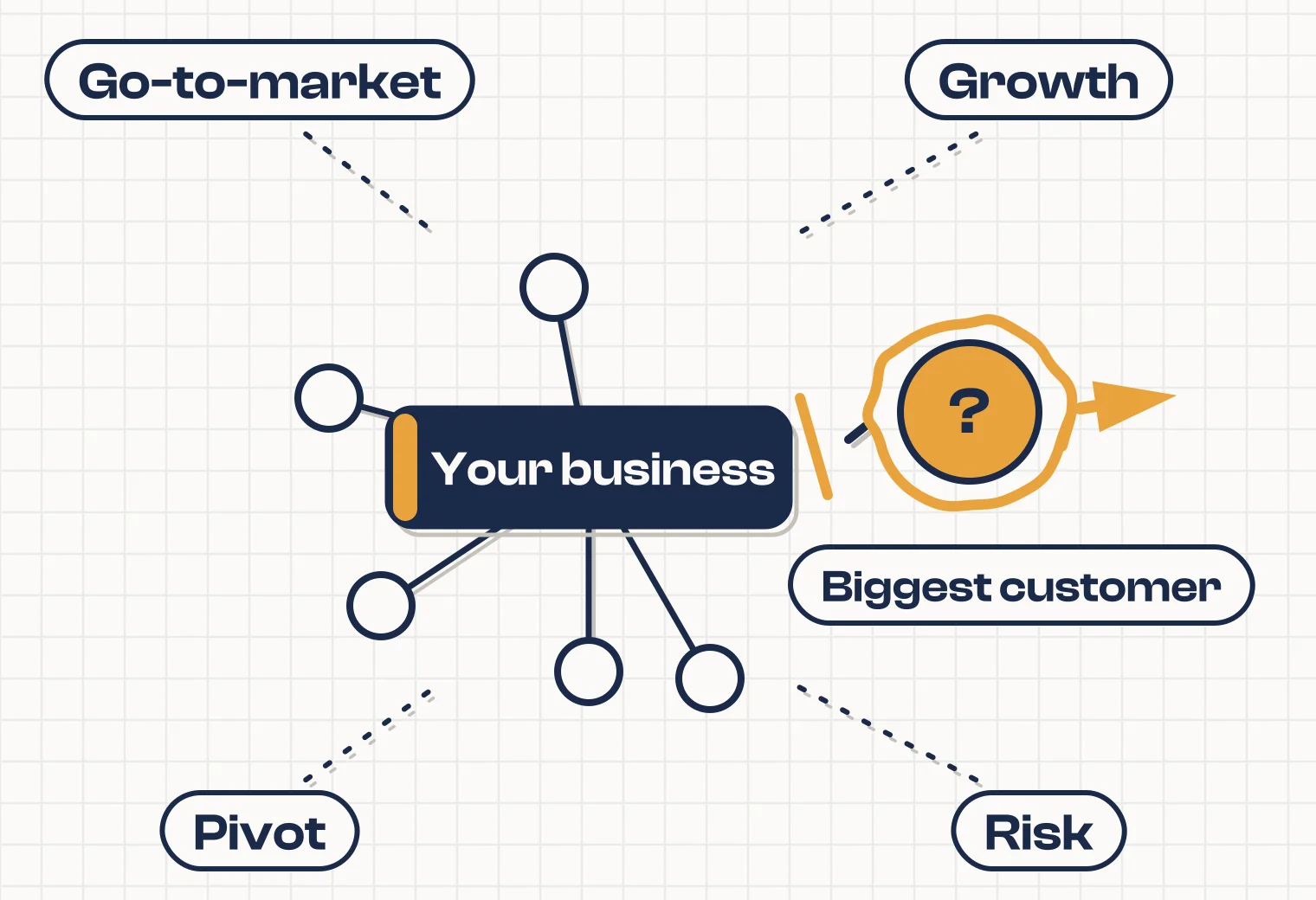
If my biggest customer walked tomorrow, what actually happens, and what should I already be doing about it? Or the braver version: where could this business go that we have never priced up? Those are systems questions, and they are the assessment's home ground: model the ecosystem, assess the chances of success or failure, describe the mitigations, and put evidence you can interrogate under the opportunities: expansion, pivot, or hold.
Four questions, one model
- Go-to-market. Which segment first, and through which channel? Segments, channels, rivals and partners on one map, and the channel tested on a twin of the business before you spend.
- Growth. Where is the next pound of profit? Your clients sorted from your own books, growth options ranked on time and on money, and the price rise or the hire tested first.
- Pivot. Is the shape still winning? The warning signs checked on a schedule, so a pivot is seen early, from strength.
- Risk. What breaks first? The top-client stress test, cash under worst and best cases, and an alert before the runway gets short.
Read moreThe decisions you take, kept and re-tested
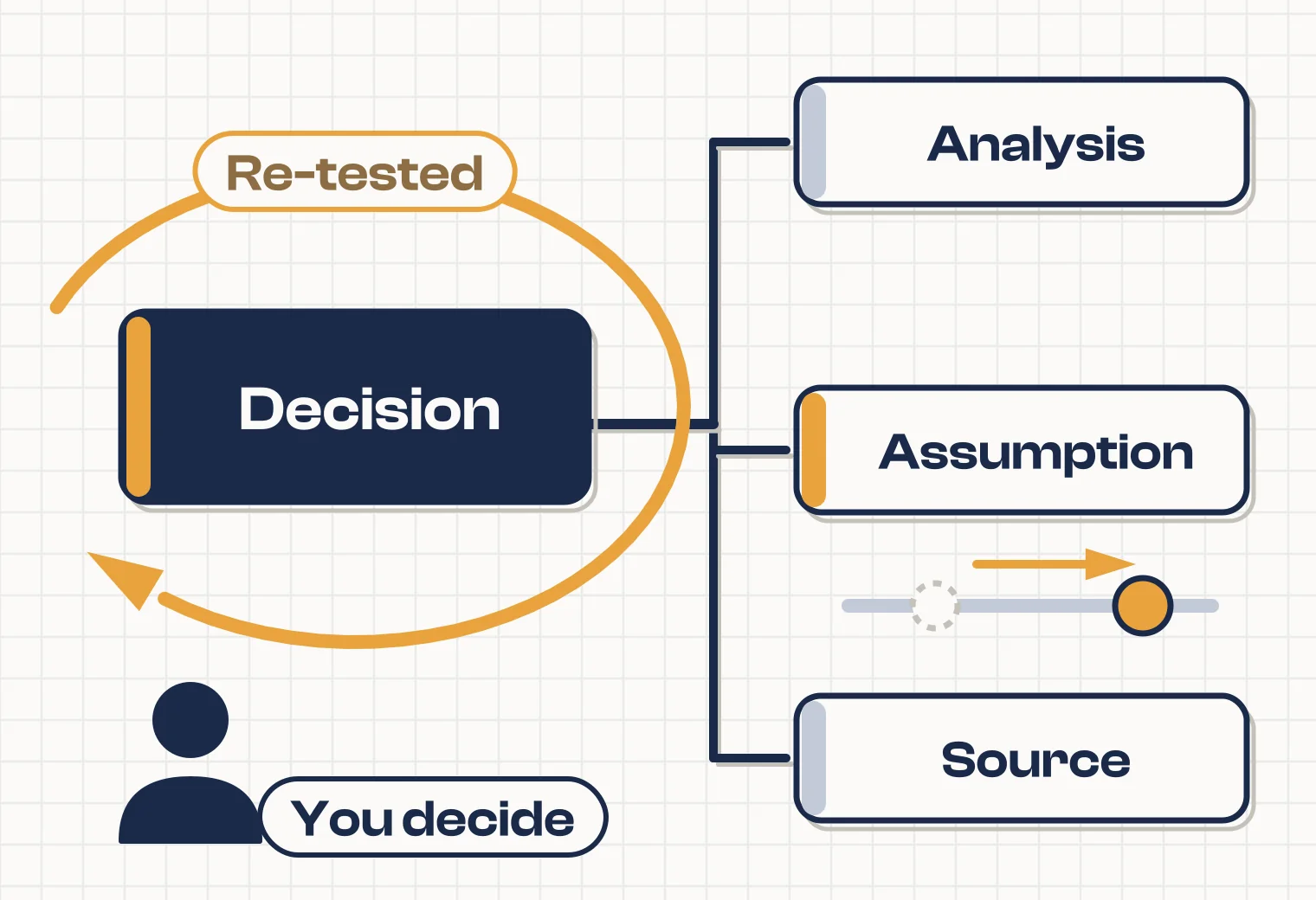
Growth, pivots and holds are decisions, and Just Good Business treats each one as a system. The decision is framed with the ecosystem it lands in built out around it, the options are tested before anything is committed, and the load-bearing assumptions are hunted by adversary agents rather than hoped for. Every claim cites a catalogued source, and judgement, formal proof and computation stay visibly separate.
Then the decision itself is kept. A committed decision carries its rationale chain (the analyses, parameters, assumptions and sources behind it) and is re-tested when those parameters move materially. That is the difference between a decision you can revisit and a slide deck you can only re-read. Just Good Business supports the decision; the person in the chair still takes it.
Free to download
Go deeper
A conversation, not a pitch
We meet a lot of businesses where innovation feels like a luxury, something for when times are better, when actually it could be the thing that saves them. The offer here is a conversation, not a pitch: tell us the question that keeps coming back, and we'll tell you honestly whether this is for you.
Send us your question and let's have a chat.