
Redstring
Story worlds that hold together
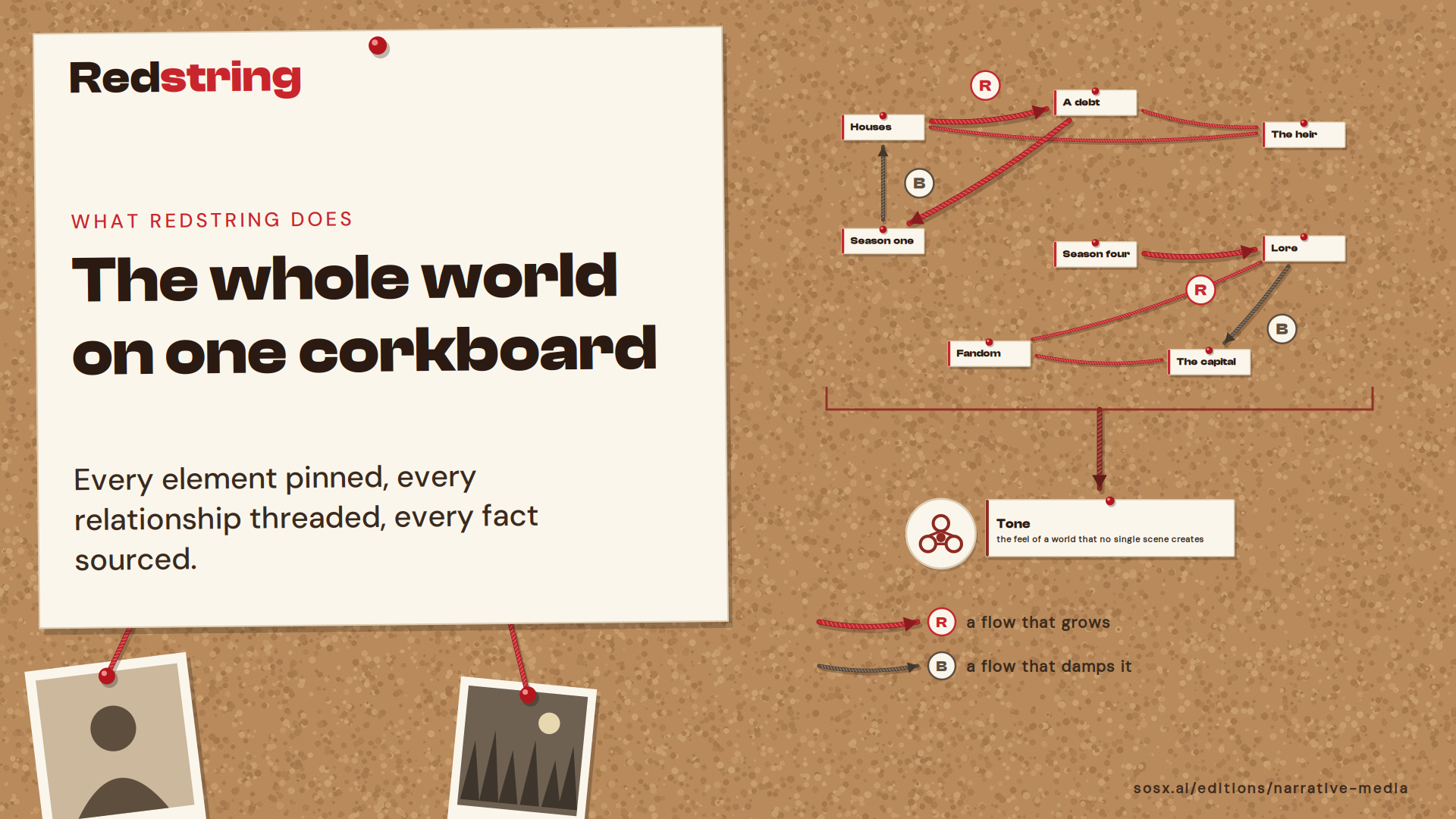
Redstring is SOSX pointed at storytelling: world building, lore development and narrative consistency for video games first, then TV, film and every other home a big story lives in. The story world becomes one living, computable model, characters, factions, places and resources as systems; obligations, information and influence as typed connections; plot dynamics as the reinforcing and balancing loops they really are.
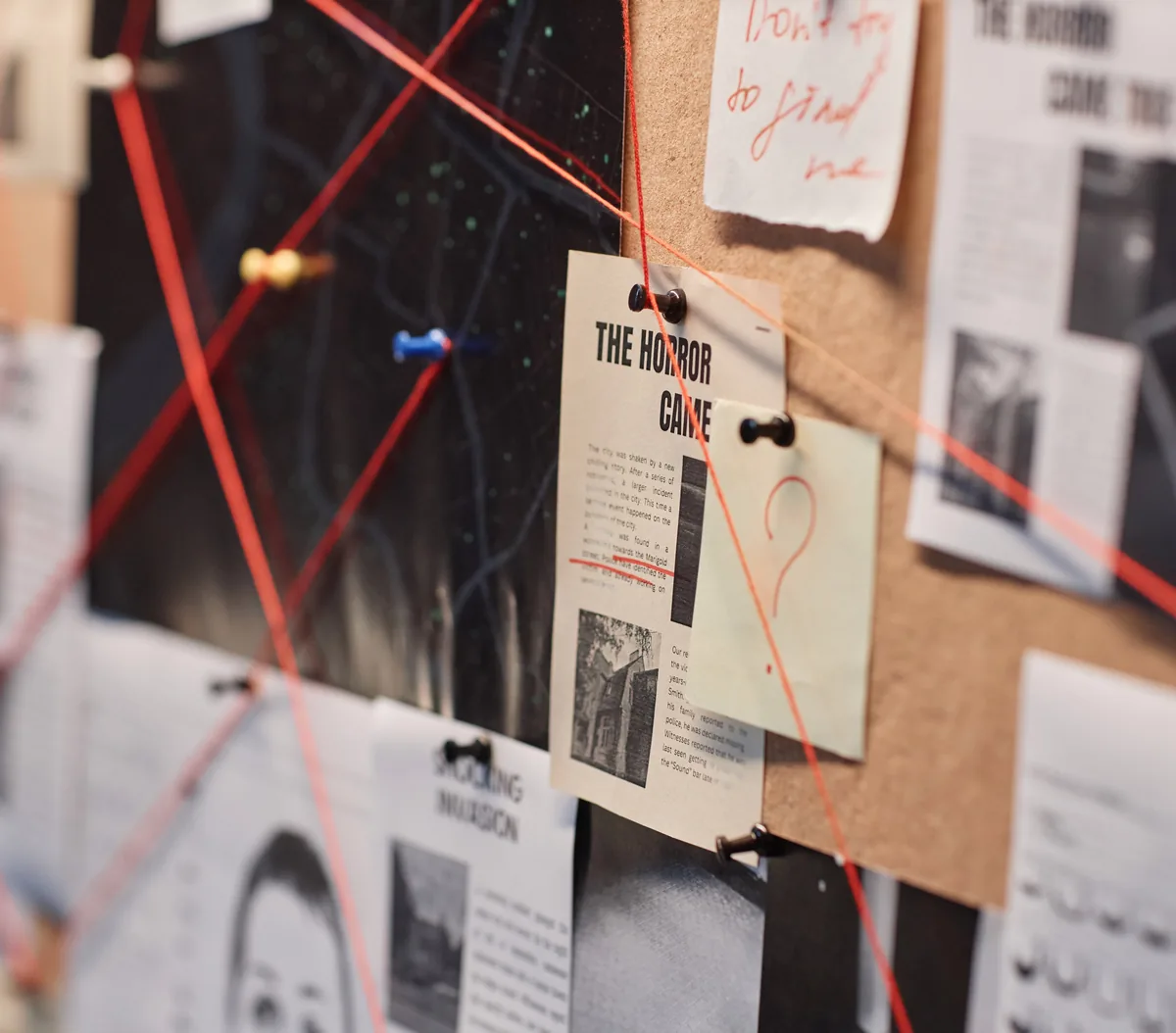
This is what Redstring gives you. The corkboard: a detective-board view of your whole world, every element pinned and every relationship threaded. The typed story-element, arc and flow model. The writers' room of author-agents, a room rather than a single oracle, with the writer always in the chair. Story options and visuals, drafted for the room to choose from. The analysis suite that reads pacing, arc-completeness, structural fitness, continuity and plot holes. And a narrative interchange that exports a world to Fountain, Twine, EPUB and Obsidian, and to screenplay, Final Draft and Ink. All of it runs on the same enterprise-grade platform that powers every SOSX product.
The problem every big story world has
Past a certain size, no one person holds the whole world. The wiki drifts. The timeline contradicts the prequel. The faction that swore revenge in season one quietly forgets by season three, and your audience does not forget, because audiences never do. Continuity is a systems problem: thousands of facts, characters and obligations, connected, changing, and maintained by hand.
Redstring treats it as the systems problem it is. Every element of the world is a node with its history; every relationship says what it carries, loyalty, debt, information, force; and when a new chapter breaks something established, the model knows, and tells you, before the fandom does.

What you get, piece by piece
The detective-board view: your world as a connected board you can interrogate, not a folder of documents that agree only by luck. The typed story-element, arc and flow schemas that hold the world's own rules. The writers' room of author-agents that draft inside those rules, and the analysis suite that reads a story world the way SOSX reads any system: for coherence, tension and the contradictions worth keeping. And the exporters, because your writers' room already has tools it loves: Fountain for screenplays, Twine for interactive fiction, EPUB for readers, Obsidian for the world bible, and screenplay, Final Draft and Ink for the room itself, and Ink carries a world straight into the narrative runtimes game engines already use. Redstring sits above your toolchain, it does not replace it.
And the joins do not stop at the page. Past a certain size, the same drift that contradicts a chapter reaches production: the environment artist dresses a district the narrative team has since made wealthy, the level contradicts the lore, and nobody notices until review. A canon that lives as one computable model is the fix's foundation: text, art and levels all answering to the same source of truth, with provenance saying which fact each of them realises.

Built for the way creative businesses actually adopt AI
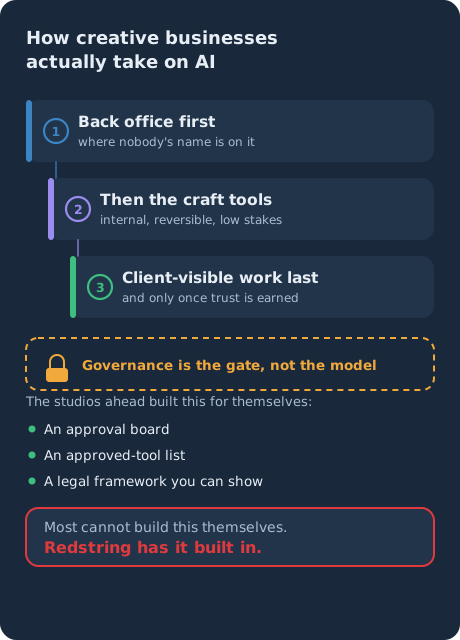
In June 2026, DCMS-commissioned research by Creative UK set out how the UK's creative businesses really take on AI: deliberately, back-office first, and client-visible work only once the governance has earned it. The studios furthest ahead all built the same things for themselves (approval boards, approved-tool lists, legal frameworks they now show to clients) because trust in AI comes from the architecture around it, not from the model. Most creative businesses cannot fund that infrastructure for themselves. Redstring comes with it already built in.
Every fact in your world carries its provenance. The changes that decide the world pass a human approval gate, and a build that raises a critical finding stops for a person. Every output can be traced back to what the machine touched and what stayed human, so when a commissioner asks how AI was used on their project, you answer in receipts, not reassurances. The same research found that the businesses who can explain their safeguards are the ones who win the work. That page of answers is what Redstring is for.
The games industry's own analysts say the same thing from the other direction. Bain's Gaming Report 2026 finds play and spending heavily concentrated: the next market leaders will not win the most players but the right ones, by owning the relationship with them, and it warns bluntly that AI alone will not rescue a game, because it scales the wrong bets as fast as the right ones. Both halves argue for Redstring: audiences that reward worlds which hold together, and generation grounded in a canon rather than scaled on hope. And it is not only a UK story: Screen Australia's Screen Currency research (2026) values screen and games at over A$11 billion a year, with games revenue more than doubled since 2016/17 and 78% of Australians playing, story-driven industries are national-scale economies wherever you stand.
And it is worth being precise about who does the work inside those economies. The German games industry's annual report for 2026, published by game, the national trade association, puts the global market at around $201.6 billion and Germany, Europe's largest, at €9.4 billion, and then reports that more than three quarters of German games companies employ fewer than ten people. In its latest year the number of companies rose while the number of people working in them fell. Worlds are getting more ambitious; the rooms holding them are getting smaller. In a studio of nine nobody holds the title of loremaster, and the job does not vanish with the post: remembering what was true in chapter one lands on whoever has least room to refuse it, late and usually unpaid. Redstring does the loremaster's work for studios too small to employ one.
And it starts where the sector starts: the back office of storytelling. Continuity, cross-references, the who-knows-what-when, the bookkeeping a big world demands, before a single client-visible word is machine-touched. The staged path creative businesses already trust is the path Redstring is built around.

Our promise to writers
Redstring supports writers' rooms; it does not replace them. The machine does the bookkeeping, so the room spends its time on the original thought: the part that wins the work and the part that was always yours. And we answer the questions your sector has learned to ask, in writing: no training on writers' work without consent, ever; your world lives where you can see it; and everything the machine does is inspectable, gated and reversible. Your world stays yours.

Go deeper
The companion book teaches the whole discipline of story worlds as systems, before the platform enters the frame.
Bring us your world
If you run a story universe (a game studio, a writers' room, a transmedia franchise) bring us the continuity problem that keeps somebody up at night, and watch the board light up.