SOSX®, AI-enabled systems thinking, for any sector.
Digital twins
Digital twins of assets, and of the problem spaces around them
A digital twin is a living model kept in step with the thing it mirrors, so you can ask it what is happening, what is connected to what, and what would happen if you changed something. Engineers have built them for machines, buildings and networks for years, and we build them for physical assets and use cases too.
SOSX extends the same idea to things that have no sensors at all: a concept, a research ecosystem, a business, the connected problem space around a decision you have to make. We call it the digital twinning of a problem space. It keeps the traits that make a twin worth having (a model that stays current, relationships made explicit, what-if questions answered by the model itself) and points them at a different purpose: not "how is this asset behaving?" but "where should we act, on what evidence, and what happens next if we do?"
What makes it a twin
The same traits, pointed at a different purpose.
| Trait | Asset twin | Problem-space twin |
|---|---|---|
| Mirrors | A machine, a building, a network | A concept, a research ecosystem, a business, a decision |
| Kept in step by | Sensors and operational data | Scheduled research reading new evidence, documents and data |
| Relationships | Components, physics and control | Systems, actors, flows and influences, every link typed and evidence-graded |
| What-if | Load, wear, failure, operating changes | An intervention, a policy, an investment, and its knock-on effects |
| Answers | How is this asset behaving, and what will it do next? | Where should we act, on what evidence, and what happens next if we do? |
What we twin
Assets and use cases
The classic twin, and the system of systems around it. SOSX Engineering works at the concept stage, where the decisions that commit most of a programme's cost are taken, and exports into the MBSE tools you already run.
Research ecosystems and concepts
A field, a programme or a body of evidence as one connected, cited network: papers, claims, methods and groups, with the contradictions and gaps made visible and kept current as new work lands.
Problem spaces and businesses
The question you have to decide about, and everything it reaches across: suppliers, regulators, markets, money. For a business, it is the formal model underneath an AI operating system.
A model you keep, not a map that was true once
Systems maps have described problem spaces for decades. They were rarely called twins, for one honest reason: they went stale the day they were drawn, because keeping them true by hand cost more than drawing them.
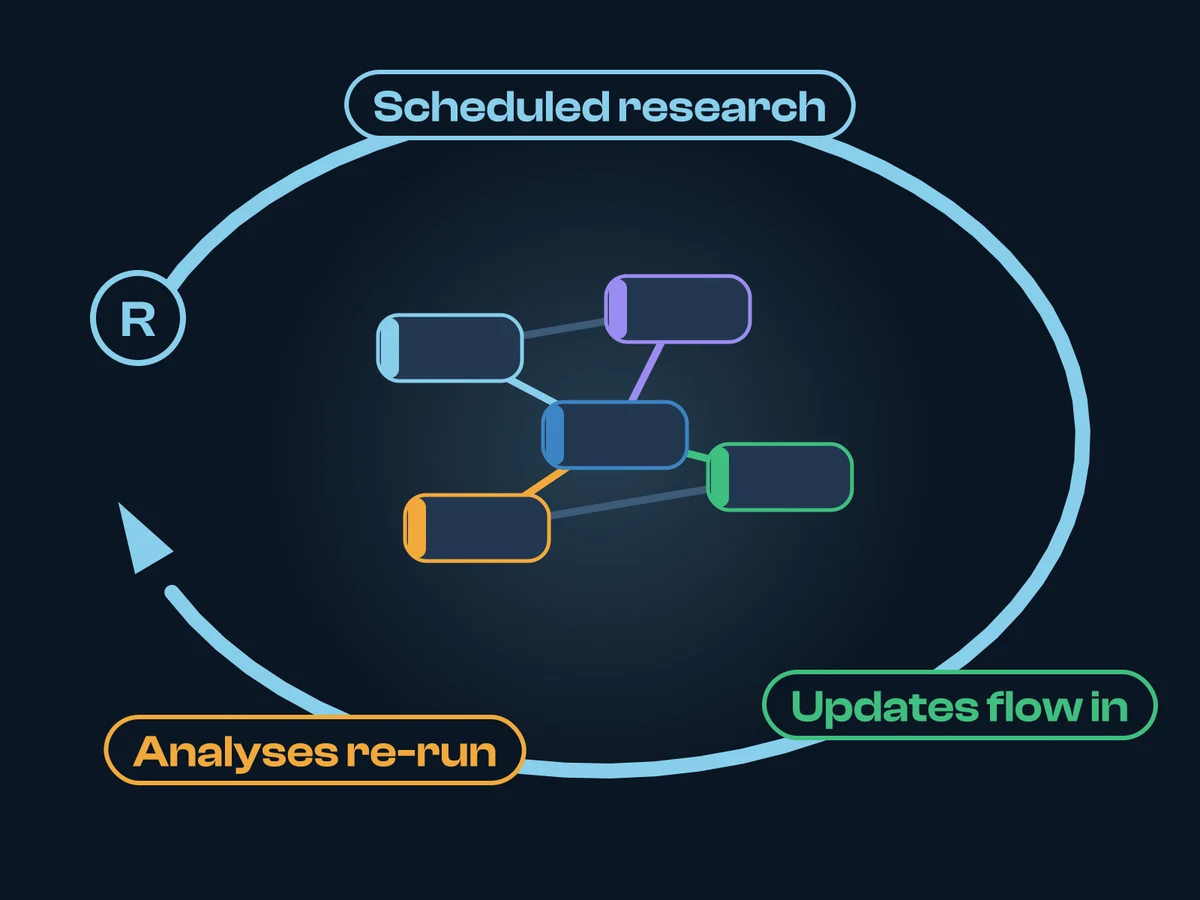
That is the part SOSX changes. It builds your problem space from first principles: the systems, actors, flows and influences around your question, researched and connected into one network, every connection typed, every value carrying its units and its confidence, every claim citing its source. Then scheduled research keeps watch on the sources underneath the model, changes flow back into it, and the analyses re-run against what changed rather than being rebuilt from scratch. An asset twin is kept in step by its sensors; a problem-space twin is kept in step by the evidence.
- Build the problem space from first principles
- Grade the evidence on every link
- Scheduled research watches the sources
- Changes flow back into the model
- The analyses re-run on what changed
Then round again, for as long as the question matters.
For each reader
Engineers
You know digital twins. Keep yours. SOSX twins the problem space around them (the suppliers, regulators, infrastructure and markets a concept-stage decision depends on), with every parameter carrying its units, its source and its confidence, and the model exports into SysML v2, Cameo, Capella and six more tools and formats.
Researchers and academics
A research ecosystem has the traits of a twin: parts, relationships, change over time and questions worth simulating. SOSX keeps one as a typed, cited network with every reference verified against its source. If you study digital twins or systems thinking, the section above on where this sits is written for you, and we would welcome the argument.
Business owners
Plenty of tools now promise an AI operating system for your business. Most are agents and integrations with nothing holding them to a shared picture of how the business works. The twin is that picture: your business and its ecosystem as one model, every AI recommendation grounded in it and traceable back to it, and you approve every step.
Where this sits
We are extending an established idea, not claiming to have invented one, and the people we most want to talk to will know the neighbouring work:
- The digital twin of an organisation, a framing popularised by Gartner, models an organisation's processes and resources so changes can be tested before they are made. A problem space is different: it is defined by the question rather than the org chart, and it usually crosses more organisations than you own.
- Cognitive digital twins add knowledge graphs and ontologies to twins of physical systems (Zheng, Lu and Kiritsis, 2022, International Journal of Production Research). SOSX shares that semantic layer, but the thing twinned is the problem, not the plant.
- The UK National Digital Twin and its Gemini Principles (Centre for Digital Built Britain, 2018) describe an ecosystem of connected twins: a system-of-systems view of infrastructure, which is the same view SOSX takes of a question.
- Systems mapping and system dynamics, from Forrester onwards, give the method: stocks, flows, feedback loops and leverage points.
What we think is different is the combination: the problem space itself as the twinned object, AI that makes keeping it current affordable, and an evidence grade on every link, with judgement, formal proof and computation kept visibly apart. If you research digital twins or systems thinking and think we have drawn that line in the wrong place, we would genuinely like to hear it.
Common questions
Is a problem-space twin really a digital twin?
It keeps the defining traits (a model of a real thing, kept in step with it, that you can question and run what-ifs on) and changes what is twinned. An asset twin mirrors a physical object through sensors. A problem-space twin mirrors a connected problem through the evidence about it, so it is kept current by research rather than telemetry.
How is it kept up to date?
Scheduled research re-reads the sources under the model (papers, standards, suppliers, your own documents and data), changes flow back into the network, and the analyses re-run against what changed rather than being rebuilt from scratch. A committed decision is flagged for another look when the parameters behind it move materially.
Can it sit alongside our existing asset twins?
Yes. We build asset twins too, and a problem-space twin is the layer around them: the suppliers, regulators, markets and dependencies an asset twin does not hold. SOSX exports into nine MBSE tools and formats, so its outputs land where your engineering models already live.
How is it different from a systems map or a knowledge graph?
A systems map is usually drawn once and goes stale. A knowledge graph holds facts. A problem-space twin is built from both ideas and then some: every connection is typed, every value carries its units and its confidence, the feedback loops are mapped, every claim cites its source, it is kept current, and the analyses run on the network itself.
Is it the same as a digital twin of an organisation?
No. A digital twin of an organisation models one company's processes and resources. A problem space is defined by the question you are asking, scoped by the boundary you declare, and usually crosses more organisations than you own.
Bring us the problem space
Bring the question your team, your programme or your business keeps circling, and we will show you what its twin looks like: the network, the evidence under each link, and the analyses it can answer today.