Analysis tools / Defending the answer
Network quality critique
“How much should we trust this model?”
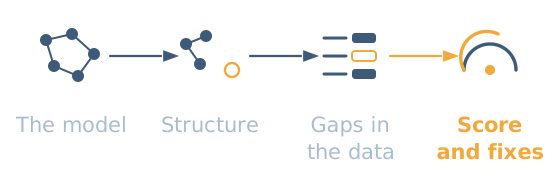
This is the analysis that tells you how much to trust the other ones. A model can be detailed, well-presented and confidently wrong, and the usual way that is discovered is late, by someone who was not supposed to be checking.
The discipline
Three kinds of problem, and they need looking for differently. Structural problems are about shape: nodes that connect to nothing, clusters that have quietly detached from the rest, bottlenecks where one node carries more of the network than anybody realised. Completeness problems are about the data: descriptions, owners and classifications that were left blank and then forgotten. Coverage problems are about the world: a domain that matters to the question and is barely represented in the model.
The third is the hardest, because the model cannot see what is not in it. It has to be reasoned about from the question the network was built to answer.
How SOSX runs it
The critique evaluates connectivity and identifies orphans, weakly-connected components and bottleneck nodes. It checks data completeness across descriptions, owners and domain classifications. It assesses whether key domains are missing or thin. Then it produces a composite quality score, and a prioritised list of recommendations with the highest-value fixes first, rather than an undifferentiated list of everything wrong.
The findings come with charts chosen for the question being asked rather than for decoration, which in practice means a small number of plain comparisons instead of a gallery.
What you get
A quality critique report with the score, the structural findings, the data completeness findings and the prioritised recommendations, exporting to PDF or Word. Run it first, before the analyses you actually care about. It is considerably cheaper to find a coverage gap here than in the trade-off study built on top of it.
The others in this group
Someone will ask how you know. These are the analyses that answer them.
Risk register
“What could go wrong, and how badly?”
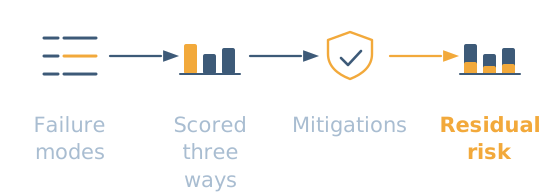
Severity, occurrence and detection in the FMEA style, scored before and after the mitigations you propose.
SWOT
“Where are we strong, and where are we exposed?”
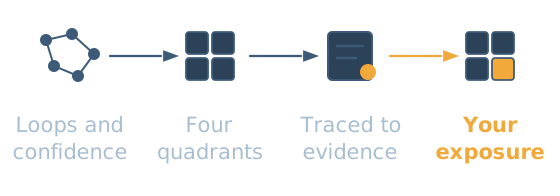
The familiar four quadrants, but built out of the model's loops and confidence levels rather than a workshop's memory.
Governance analysis
“Who decides this, and who has to be told?”
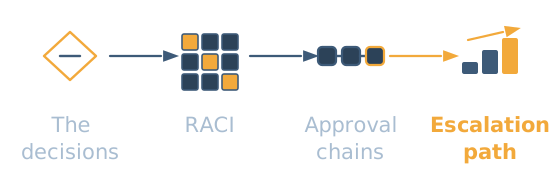
Decision rights, accountability and escalation paths, as a RACI matrix and the approval chains behind it.
Compliance analysis
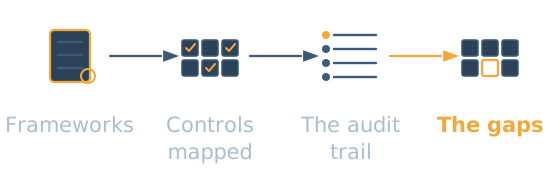
“What does the audit trail show, framework by framework?”
SOSX's own audit evidence for a network, scored control by control against the governance frameworks it aligns with. Alignment, not certification.
Or see all the analysis tools. If you would rather we built the model and ran them for you, that is our system research, build and analysis service.