

Redstring
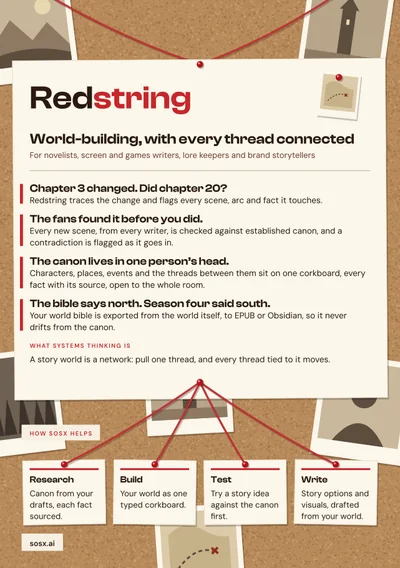
World-building, with every thread connected.
Redstring, powered by SOSX, models a story world as one living, computable system, so that games and screen writing stay consistent, supporting human writing teams, never replacing them.
The problems it solves
- “Our world has outgrown its wiki.”
- “A character was in two places in the same week, and nobody noticed until the read-through.”
- “Every new writer spends weeks learning the canon.”
- “One late change to a storyline quietly broke three others.”
Redstring: World-building, with every thread connected
See Redstring at work
The craft this serves 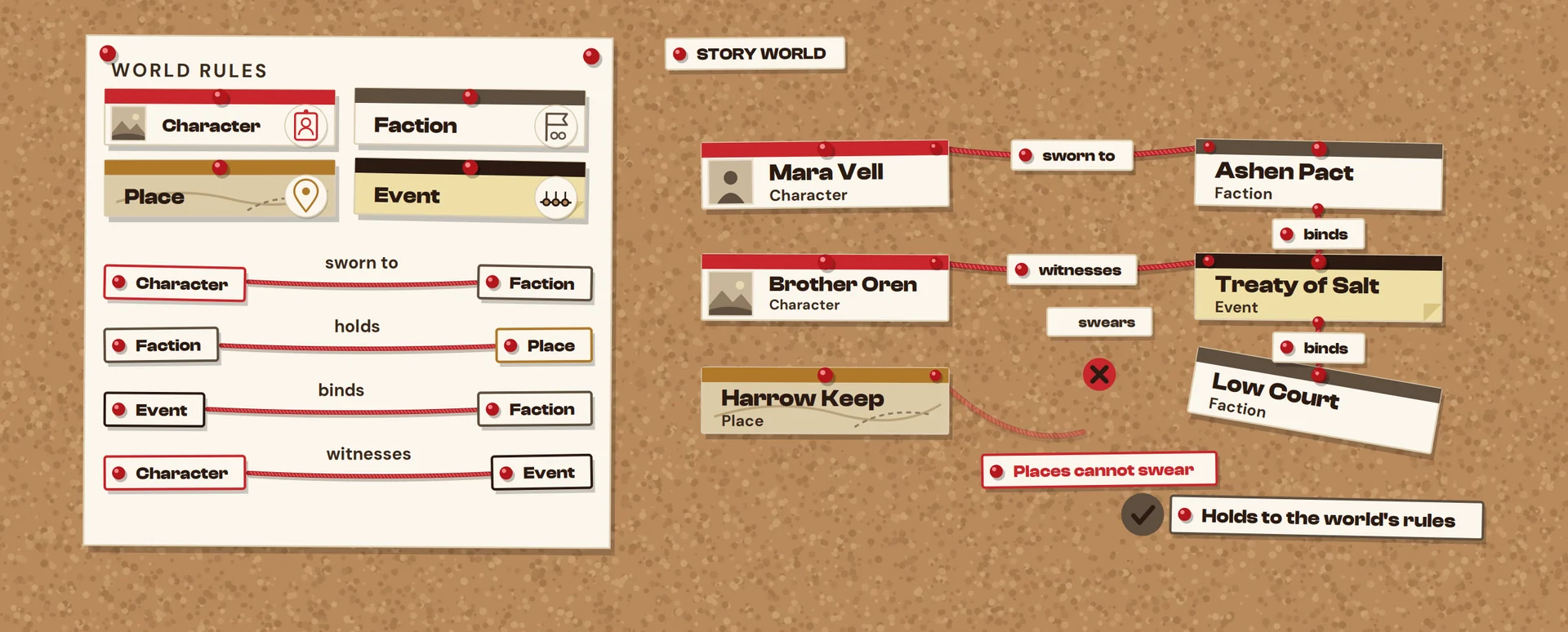
What the platform gives a story world 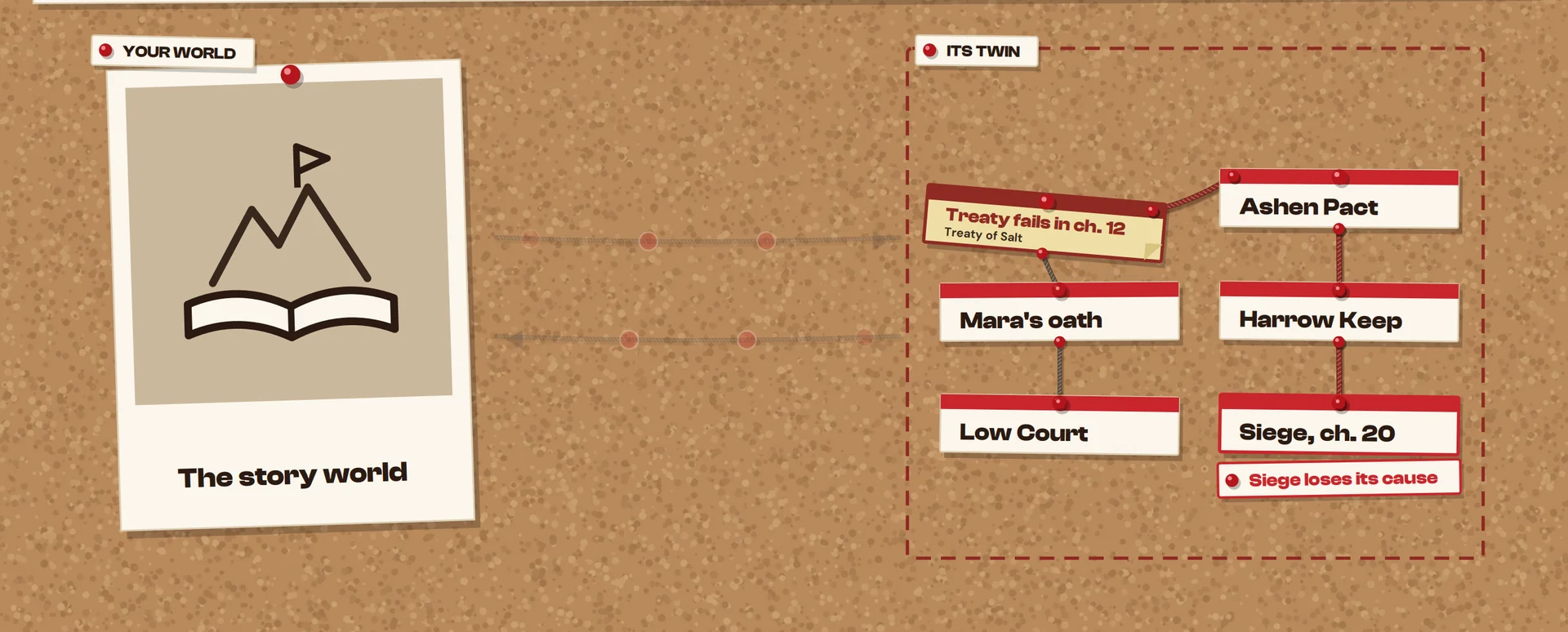
The question a lore lead would ask 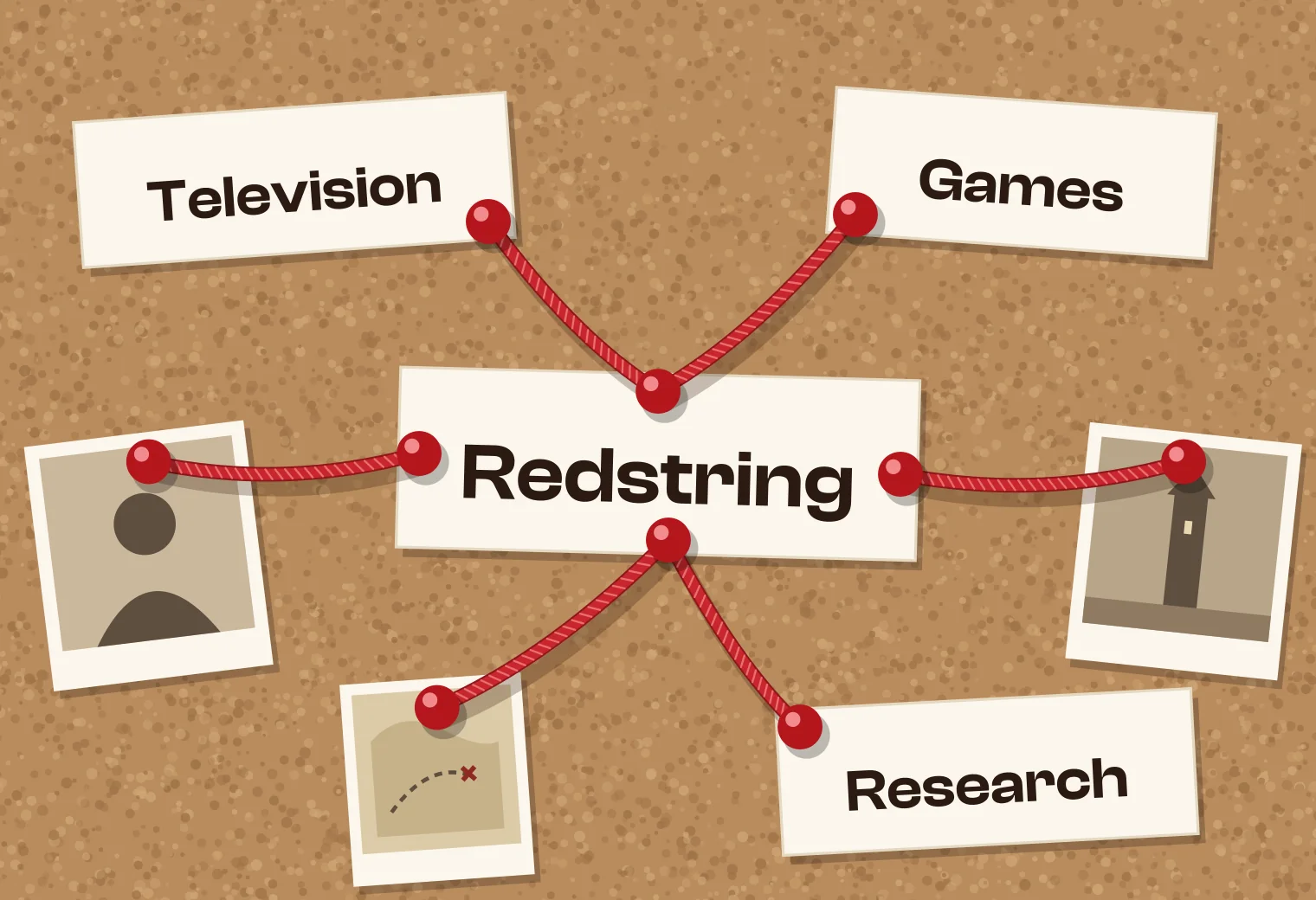
Why Redstring, from us
How SOSX helps
Research
Specialised agents research the question, every claim citing a source.
Build
One typed, connected network, every value with its units and confidence.
Analyse
What-if, feedback loops, dependencies, trade-offs, risk and ROI.
Report
SWOTs, risk registers and decision reports, red-teamed before you see them.
The detail
For when you want the whole argument.
Read moreWhat Redstring does
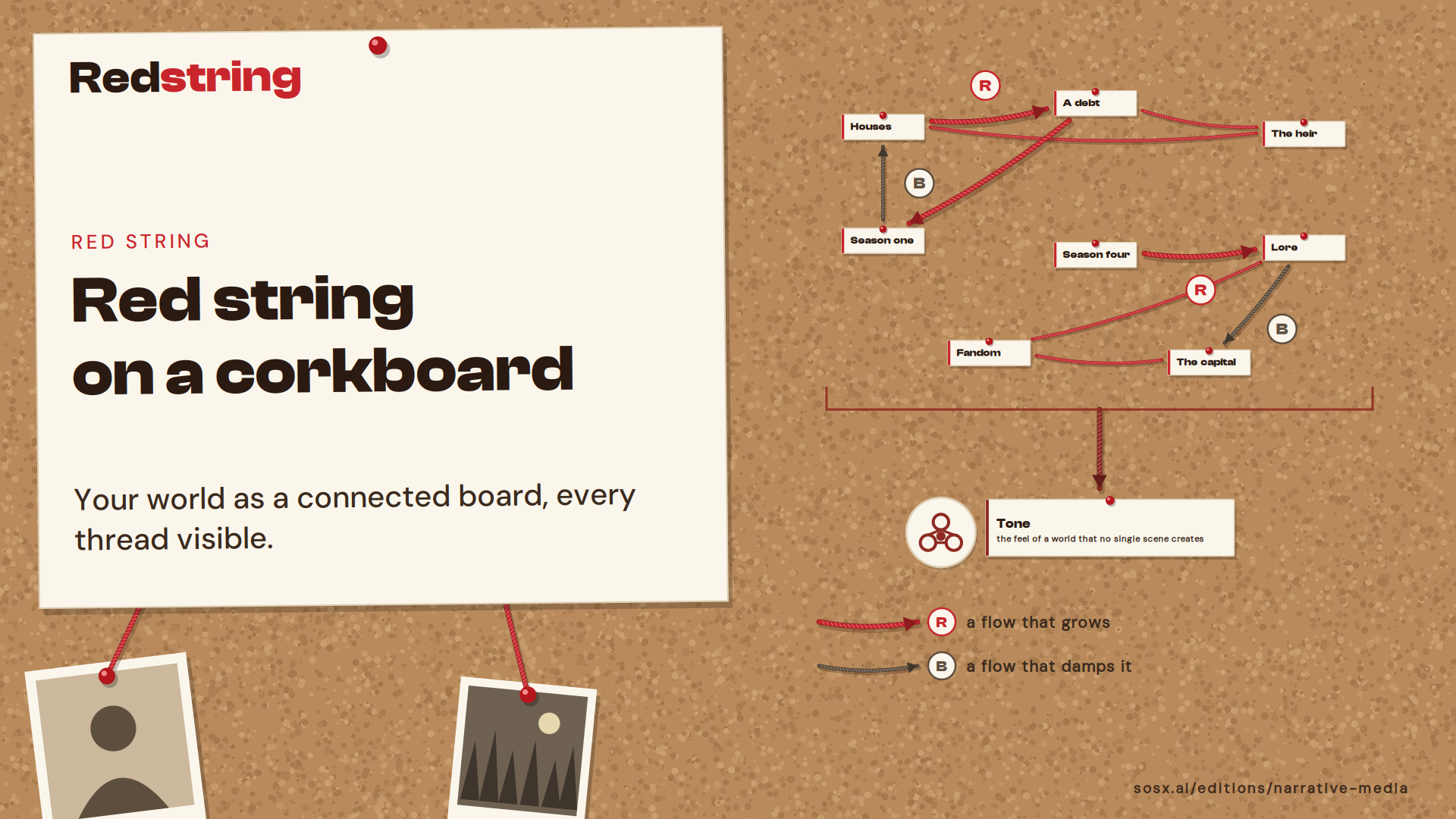
Think of a soap opera. Every household on the street is a system; the features and relationships inside it are sub-systems, components and actors; the drama is the reinforcing and balancing flows of finance and emotion (love, desire, hate) running between them. That is systems thinking, and it is exactly how Redstring treats a story world.
Redstring, powered by SOSX, is AI Accelerated Storycraft, named Red String after the photos, red-string and cork board motif you see in crime dramas. Its home screen is exactly that: a corkboard, a detective-board view of your world where the threads between things are the point. The proposition: your story world as one living, computable, typed model (characters, plots and subplots, beats, events, settings and resources (the people, the threads, the moments, the places and the things of value a plot turns on)) and from that world Redstring derives the narrative: lore bibles, character arcs and narrative events, consistent by construction, with provenance on every value. The AI does prose realisation of structure the world already carries, with its provenance attached: the grounded bedrock for something humans make richer. Never free generation, and never a replacement for writers.
This is what Redstring gives you. The corkboard view. The typed story-element, arc and flow model. The writers' room of author-agents, with the writer always in the chair. Story options and visuals, drafted for the room to choose from. The analysis suite. And a narrative interchange that exports your world to Fountain, Twine, EPUB and Obsidian, and to screenplay, Final Draft and Ink. All of it runs on the same production-grade platform that powers every SOSX product.
Read moreThe craft this serves
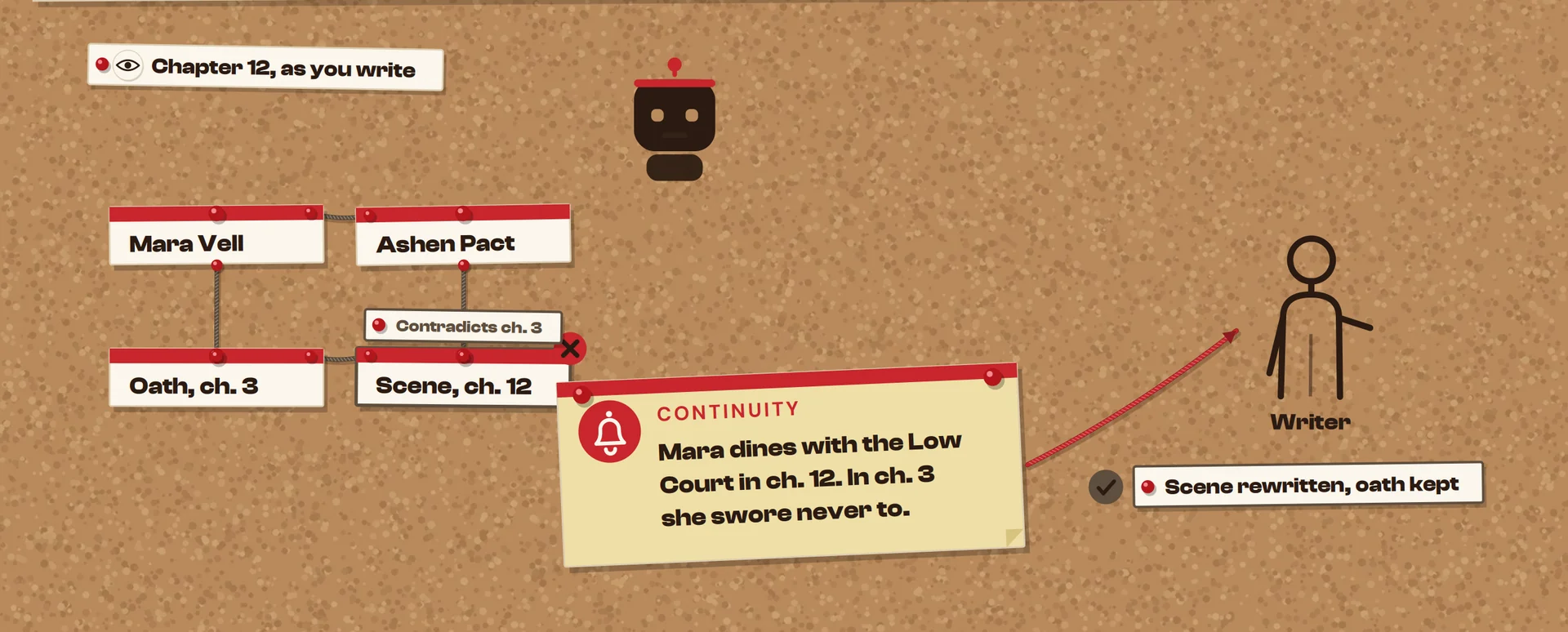
Long-form world building has a craft behind it, and it was managing perfectly well before anyone offered it software. A canon bible somebody owns and everybody updates. Character arcs tracked so a change in episode nine still pays in episode thirty. Continuity passes before the table read rather than after transmission. Pacing read as a shape over time instead of a feeling on the day. Structural frameworks (three-act, the hero's journey, save the cat) used as diagnostics rather than as moulds. And a writers' room, which is really an adversarial validation machine made of people: somebody in it is paid to say that this alliance would not turn here.
Writers have always borrowed from the social sciences to keep worlds honest, and the borrowings are worth naming. Mintzberg's thirteen political games read as faction plot generators. French and Raven's five bases of power say what one character can actually do to another: which is a typed relationship whether or not anybody types it. Lukes' account of power includes the power to keep something off the agenda entirely, which is how you write oppression without a villain. Axelrod's work on tit-for-tat gives alliance-and-betrayal arcs their logic. Goffman and Berne explain why a character still sounds like themselves two hundred episodes later. Hofstede is where cross-cultural world building stops being costume.
All of it can be done with index cards, a wiki and a long memory, and the sharpest rooms do exactly that. The cost is upkeep: the thousandth hour of lore staying consistent with the first, across writers who joined at different points and a world nobody now holds in one head. The expensive part is not drawing the world: it is building it and keeping it true. That is the part Redstring takes off you.
Read moreWhat the platform gives a story world
Redstring inherits a working platform rather than starting from zero. The same engine that maps an engineering ecosystem as a typed, connected network can hold a street, a city or a galaxy: every character, plot, event and setting a typed node; every relationship an arc with a direction and a kind: a rivalry, a romance, an alliance, a betrayal, a cause-and-effect, a piece of foreshadowing that pays off forty episodes later; every established fact carrying its provenance, so the thousandth hour of lore stays coherent with the first.
Between those nodes run the flows a story lives on. Some are what characters feel, emotion and the tension it builds. Some are what they pursue and what stands to be won or lost, power and influence, the stakes, the money. And some are how the story moves, its momentum and its sense of time pressure. Redstring models these as directional flows that reinforce or balance, and to hold the coupling between them, because a character is the junction where what they want meets what they feel and one bends the other: which is exactly where continuity and drama live. In plain terms, a character's drive is just the human reading of their power and stakes flows; model the feeling and the pursuit together and the network tells you where the story turns.
Around that model sits the part that makes it a tool rather than a diagram:
- A writers' room, not a single oracle. Seven author-agents (a showrunner, a character writer, a plot architect, a dialogue specialist, a continuity editor, a genre expert and a script doctor) work the world from their own angles, with the writer always in the chair.
- An analysis suite that reads structure, not vibes. Pacing and tension-over-time curves, character-arc completeness, theme coherence, structural-fitness scoring against three-act, save-the-cat and the hero's journey (with the beats mapped), plus continuity, plot-hole, dropped-thread and trope checks, and a script-doctor red-team pass that argues with your draft.
- Medium fitness. The same world scored for how well it suits a novel, a short story, a screenplay, a TV series or episode, a film, an audiobook, a video game, interactive fiction, a stage play or a comic.
- Real exports. Your world leaves Redstring as Fountain, Twine, EPUB and Obsidian, and as screenplay, Final Draft (FDX) and Ink.
Three commitments sit alongside it:
- Video games first, then screen, TV, film and other storytelling.
- Supporting human production teams, never replacing them; provenance is visible in the interface, so you can always see where a value came from.
- We will not train on writers' work without consent. The whole system is built as governed AI, aligned to ISO/IEC 42001 and the EU AI Act, with energy and carbon telemetry.
Read moreThe question a lore lead would ask
Picture a lead writer three seasons deep: if this alliance turns to betrayal in the mid-season finale, what breaks? Which established facts, which character arcs, which promises made to the audience forty episodes ago? Today that answer lives in wiki archaeology and the memory of whoever has been on the show longest. With Redstring it is a query on the world model, every affected thread surfaced with its provenance, so continuity checking stops eating the writers' room and the argument can be about the drama, not the database.
Read moreWhy Redstring, from us
Narrative media is not a market we picked from a spreadsheet. Chris Dean, who built SOSX, spent a decade as Head of Technology at Endemol Shine UK, the British arm of one of the world's largest independent television production groups, and never really left the sector; Digital Tactics still stewards the Banijay UK / Endemol domain estate today. He is a regular at Develop:Brighton. Over the years the company has worked with, bid to, or taken part alongside organisations across the games and media industries, among them Fremantle, Creative Assembly and the Sustainable Games Alliance. We list them as organisations we have dealt with, not as clients, because the shapes differ: some were projects, one was an invitation to bid we chose to stand down from, and one is a network we participate in. On the research side, the questions Redstring raises are live ones in UK games research, where there is genuine academic interest in generative AI for narrative development.
We say this for one reason: we build Redstring inside the industries that use it, not at a distance from them.
Free to download
Go deeper
Bring us your world
The studios and writers who talk to us shape where Redstring goes next, and it is rarely the studio with the largest bible that moves first; it is the one that has just been caught out. If you run a story world that has outgrown its wiki, that is precisely the point Redstring is built for.
Redstring has its own page: the full story lives at sosx.ai/redstring.
Send us your question and let's have a chat.