Analysis tools / Testing a change
Bayesian optimisation
“What settings give us the best outcome?”
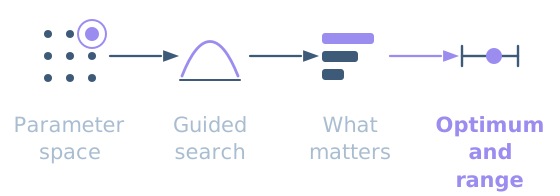
There is a point in most programmes where the structure is settled and the argument moves to settings. How much capacity, what price, which threshold, how many of them. The search space is too large to try by hand, and the instinct to sweep every combination collapses the moment there are more than three dials.
The discipline
Optimisation is only as honest as the three things around it. You need an objective stated plainly enough that a number can be better or worse against it. You need to know which inputs actually matter, because optimising a parameter the objective barely responds to is a way of looking busy. And you need the uncertainty carried through, because an optimum that is only optimal at one precise set of assumptions is a liability dressed as a result.
The output worth having is not a single best answer. It is a best answer, the inputs that drove it, and the range it holds over.
How SOSX runs it
Three methods work together. Bayesian optimisation searches the parameter space efficiently, with configurable acquisition functions so the balance between exploring and exploiting is a choice rather than a default. Sensitivity analysis ranks the parameters by how much each one moves the objective, which usually shortens the list of things worth arguing about. Monte Carlo simulation then quantifies what is left, returning confidence intervals rather than a point estimate.
It runs on the same unit-normalised parameters as every other analysis, so an objective spanning cost, time and emissions is being optimised on one lens rather than on three incompatible scales.
What you get
The optimised parameter set, the sensitivity ranking behind it, and confidence intervals around the result. As with every analysis, the report exports to PDF or Word and carries an explainability companion documenting the conversion chains and assumptions, which matters more here than almost anywhere else: an optimisation result with no stated assumptions is a number with no argument attached.
The others in this group
Something in the system moves, and you need to know what moves with it.
What-if analysis
“What happens if we change this one thing?”
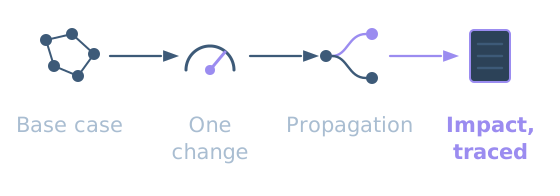
A hypothetical change written into a scenario copy of the network, and the impact traced through the feedback loops.
Deep analysis
“How does this system actually behave over time?”
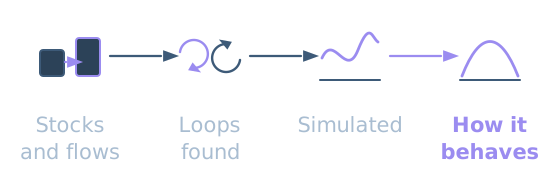
System dynamics: the reinforcing and balancing loops, how they interact, the emergent properties no single part accounts for, and where the system is brittle.
Or see all the analysis tools. If you would rather we built the model and ran them for you, that is our system research, build and analysis service.