Analysis tools / Testing a change
What-if analysis
“What happens if we change this one thing?”
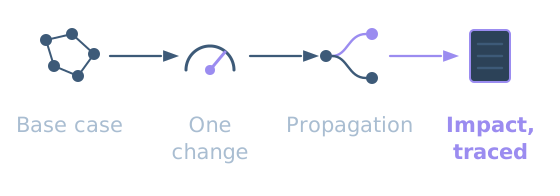
"What if the supplier slips two quarters?" is the most common question in any programme and the one most often answered from memory. The answer people give is usually the first-order effect, because that is the one a human can hold in their head. The effects that hurt are second and third order, arriving through a loop nobody was looking at.
The discipline
A scenario is only worth running if three things hold. The change has to be stated precisely enough to be wrong. The base case has to survive the exercise unaltered, so you can still tell what the change did. And the propagation has to be traced rather than asserted, which means following the connections out from the change until the effects die away or come back around.
That last point is where systems thinking earns its keep. A change that feeds a reinforcing loop does not decay, it compounds, and the difference between those two behaviours is the difference between an inconvenience and a programme reset.
How SOSX runs it
You ask the question in your own words. SOSX interprets it against the network and shows you its interpretation before it runs anything, so a misreading is caught in seconds rather than discovered in the report. A compound question, the sort that quietly contains three scenarios, is broken apart and handled as such rather than averaged into one muddy answer. If the question needs narrowing, it asks.
The scenario is then written to its own copy of the network rather than over the top of it. Your base case is untouched, the scenario is a first-class object you can return to, and comparing the two afterwards is a normal operation rather than a reconstruction.
What you get
A scenario network you can keep, and an analysis report that states what was explored, how it was mapped onto the model, which feedback loops were affected and what the impact was. It exports to PDF or Word, and the explainability companion records the assumptions the scenario rests on, which is usually the first thing a sceptical reader wants to see.
The others in this group
Something in the system moves, and you need to know what moves with it.
Deep analysis
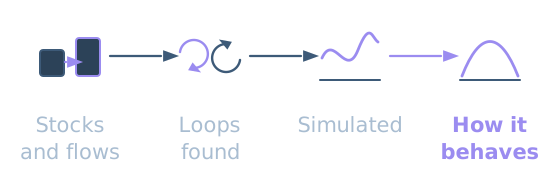
“How does this system actually behave over time?”
System dynamics: the reinforcing and balancing loops, how they interact, the emergent properties no single part accounts for, and where the system is brittle.
Bayesian optimisation
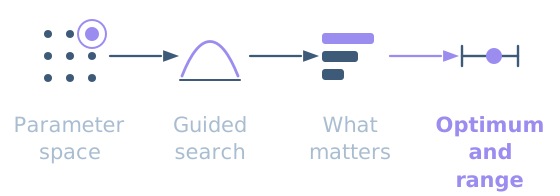
“What settings give us the best outcome?”
Network parameters optimised, ranked by how much each one moves the objective, with the uncertainty quantified.
Or see all the analysis tools. If you would rather we built the model and ran them for you, that is our system research, build and analysis service.