Analysis tools / Testing a change
Deep analysis
“How does this system actually behave over time?”
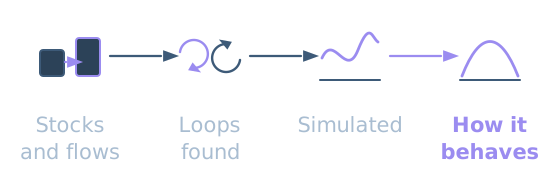
Most systems misbehave for structural reasons, not because somebody made a mistake. The behaviour that frustrates everyone, the fix that works for a quarter and then stops, the capacity that fills as fast as you add it, comes out of the arrangement of the parts rather than out of any one part. You cannot argue with that from a list of components.
The discipline
System dynamics is the practice of reading a system as stocks, flows and the loops that connect them. Reinforcing loops amplify: growth feeding growth, or decline feeding decline. Balancing loops resist: the system pulling back towards a level it prefers. Nearly every stubborn behaviour in an organisation is a reinforcing loop running into a balancing one, and the interesting question is which one is currently winning and what would change that.
Find the loops and the behaviour stops being mysterious. It also stops being fixable by exhortation, which is usually the more valuable finding.
How SOSX runs it
The analysis reads the network and identifies its feedback loops, both reinforcing and balancing, then works out how those loops interact rather than treating each as a standalone story. On top of that it assesses the properties that emerge from the structure, the ones that belong to no single component, and where the system is resilient or vulnerable.
It also generates a causal layer: the abstract causal variables behind the concrete nodes, so the argument can be read at the level at which system behaviour actually operates. The loops are captured as structured data alongside the prose, which is what lets the rest of the platform reason over them rather than just display them.
Quantitative simulation runs over a horizon you choose, so the question is not only what the structure implies but what it implies by 2030.
What you get
A system dynamics report naming the reinforcing loops, the balancing loops, their interactions, the emergent properties, a resilience assessment and recommendations. The structured loop data comes with it, as does the explainability companion, so a reader can check the reasoning rather than accept the diagram.
The others in this group
Something in the system moves, and you need to know what moves with it.
What-if analysis
“What happens if we change this one thing?”
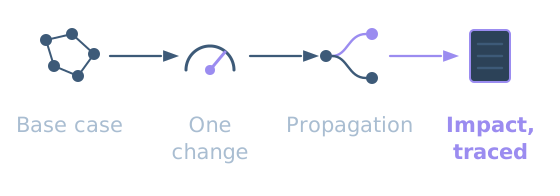
A hypothetical change written into a scenario copy of the network, and the impact traced through the feedback loops.
Bayesian optimisation
“What settings give us the best outcome?”
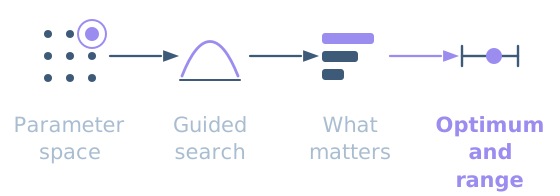
Network parameters optimised, ranked by how much each one moves the objective, with the uncertainty quantified.
Or see all the analysis tools. If you would rather we built the model and ran them for you, that is our system research, build and analysis service.