Analysis tools / Choosing between options
Comparative study
“How do these options compare, fairly?”
The honest way to compare three routes is to model all three properly. The usual way is to model the favourite properly and sketch the other two, then present the comparison as if all three had the same work behind them.
Even with the best intentions it goes wrong. Three teams modelling three options will make three different structural choices, and by the time the comparison is drawn there is no surface the numbers can meet on.
The discipline
A fair comparison is settled before the options are built, not after. That means agreeing three things up front. The dimension you are actually varying, and the values it takes. The backbone every variant has to carry, so the things that ought to be the same are the same. And the entities that appear in all of them, the regulator, the shared infrastructure, the demand you are all chasing, held as one thing rather than modelled three times with three sets of assumptions.
Do that and the differences you find are real. Skip it and you are comparing modelling styles.
How SOSX runs it
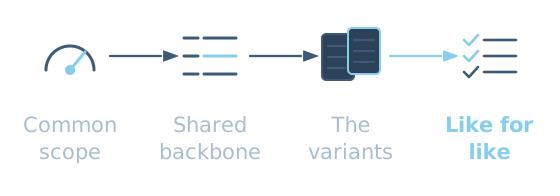
The Comparative Study Designer is the upstream step that makes the comparison possible. It walks five stages: the common scope and the dimension being varied; the shared backbone of top-level categories every variant must contain; the cross-network entities that carry stable identities across all of them; the per-variant specification; and the sources and validation checklist, generated from the structure rather than written from memory.
Each variant can come from a network you already have, from a fresh build against that variant's seed, or from an import. When you finalise, every unbuilt variant is materialised, one atomic checkpoint at a time, so a failure on one does not undo the others and the run resumes where it stopped rather than starting again.
What you get
A structured specification for the study and a machine-readable sidecar beside it, one network per variant, and a per-study audit trail recording every step and every AI-assisted call that went into them.
From there the variants are ordinary networks: the analyses run on each, and their reports sit side by side on the common scope you set at the start.
The others in this group
Several routes are on the table and one of them has to be argued for.
Trade-off analysis
“Which option wins, and what does it cost us elsewhere?”
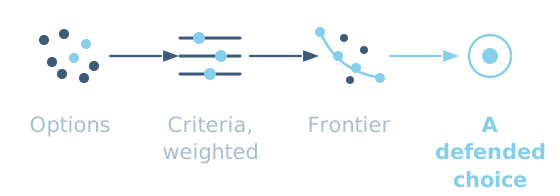
Multi-objective comparison across systems or scenarios, with the Pareto frontier drawn and the sensitivity caveats attached.
Compare models
“Which AI model does this work best?”
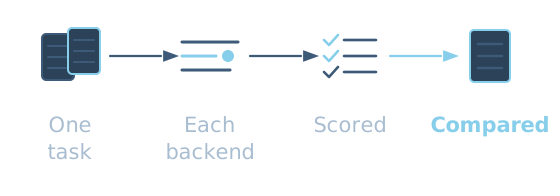
The same task on the same network, run by several AI backends, with time, cost, carbon and output quality set side by side.
Product explorer
“What should this product actually be?”
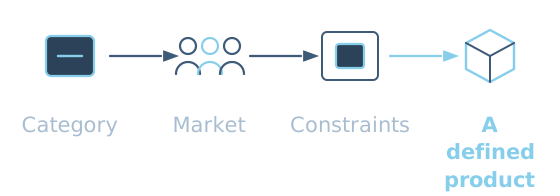
A guided exploration of category, market, performance, constraints and design trade-offs, held inside the network.
Or see all the analysis tools. If you would rather we built the model and ran them for you, that is our system research, build and analysis service.