Analysis tools / Choosing between options
Compare models
“Which AI model does this work best?”
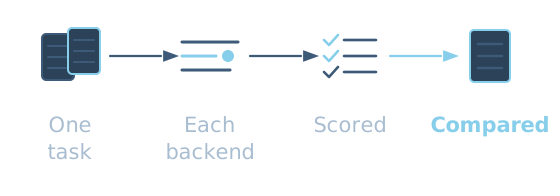
Which AI model should do this work? The question sounds technical and is really a judgement about the work itself. A model that is quicker and cheaper on a general benchmark can be the weaker choice on your network, and the only honest way to find out is to give each candidate the same job and look at what comes back.
The discipline
A fair comparison holds everything still except the thing being compared. Same network, same task, same instructions: only the model changes. Then it keeps two questions apart. The first is what each run cost: time, tokens, money and energy. The second is what each run was worth: whether the output was accurate, complete and consistent.
Neither number decides on its own. A cheaper model that drops half the answer is no saving, and a better answer may not be worth five times the cost for a routine pass.
How SOSX runs it
Name the network, the backends you want to compare and the task, and SOSX gives each backend the identical task on the identical network. It records each run's execution time, token usage, cost and estimated carbon, then scores each output for accuracy, completeness and consistency. If one provider fails, the comparison carries on with the others and says which one did not complete.
What you get
A comparison table with the quickest, cheapest, lowest-carbon and highest-quality run each marked, the detailed per-backend results behind it, and a summary. It is the evidence to have in hand when you choose which model your team's analyses run on.
The others in this group
Several routes are on the table and one of them has to be argued for.
Trade-off analysis
“Which option wins, and what does it cost us elsewhere?”
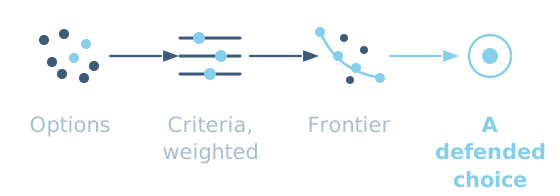
Multi-objective comparison across systems or scenarios, with the Pareto frontier drawn and the sensitivity caveats attached.
Comparative study
“How do these options compare, fairly?”
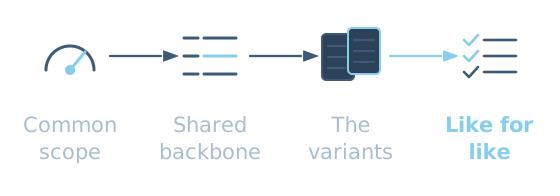
Several variants built to one shared backbone, so the comparison is like for like rather than six differently-shaped models nobody can line up.
Product explorer
“What should this product actually be?”
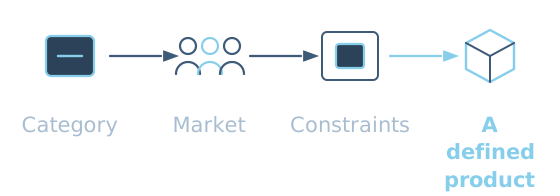
A guided exploration of category, market, performance, constraints and design trade-offs, held inside the network.
Or see all the analysis tools. If you would rather we built the model and ran them for you, that is our system research, build and analysis service.