Analysis tools / Choosing between options
Trade-off analysis
“Which option wins, and what does it cost us elsewhere?”
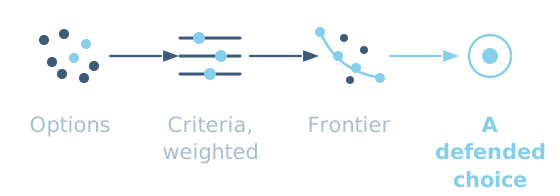
Nothing interesting has one objective. Cost fights schedule, schedule fights risk, risk fights the thing everybody actually cares about, and the honest answer is rarely "option B" on its own. It is "option B, and here is what we gave up to get it."
The discipline
A trade-off study earns its name when three things are true. The criteria are declared before the options are scored, so the weighting cannot be reverse-engineered from the answer someone already wanted. The options that are strictly worse on every count are removed, leaving the set where choosing means genuinely giving something up. And the result is tested for how far an input can move before the ranking flips, because a recommendation that survives only at one exact number is not a recommendation.
That last one is the part most trade-off decks skip, and the part a review board asks about first.
How SOSX runs it
The analysis works on the parameters already carried by your network, so there is no separate spreadsheet to reconcile. Each parameter port is classified as tradeable or fixed: tradeable ports are free to move during the study, fixed ones are the constraints you are not allowed to negotiate away. That classification lives with the analysis session, not with the model, so exploring a trade space never edits the network underneath it.
From there you pick how hard to look. A quick Pareto scan screens the option set fast. A full trade-off analysis runs Pareto and weighted scoring together. A scenario sweep varies parameters systematically within bounds you set, rather than one at a time by hand. The underlying method can be Pareto, weighted scoring, Bayesian, sensitivity or Monte Carlo, and the analysis can cover the whole network or a domain, a set of nodes or a parameter group you nominate.
Because every parameter is unit-normalised before anything is compared, objectives in different units are being weighed on one lens rather than on a guess about what "high" means in each.
What you get
A grounded markdown report, exportable to PDF or Word, carrying the non-dominated set, the weighted ranking, the sensitivity findings and the assumptions each rests on. Alongside it, the explainability companion records the conversion chains and confidence levels, so the question "where did this number come from" has an answer that is not "the model".
The others in this group
Several routes are on the table and one of them has to be argued for.
Compare models
“Which AI model does this work best?”
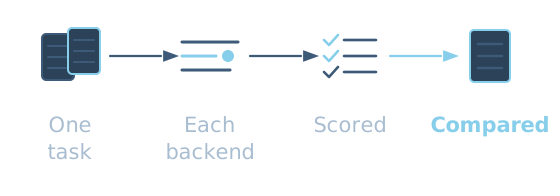
The same task on the same network, run by several AI backends, with time, cost, carbon and output quality set side by side.
Comparative study
“How do these options compare, fairly?”
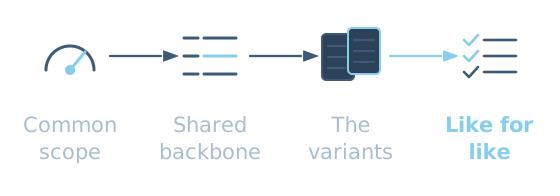
Several variants built to one shared backbone, so the comparison is like for like rather than six differently-shaped models nobody can line up.
Product explorer
“What should this product actually be?”
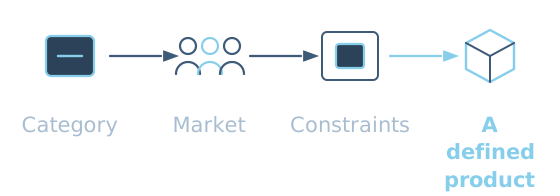
A guided exploration of category, market, performance, constraints and design trade-offs, held inside the network.
Or see all the analysis tools. If you would rather we built the model and ran them for you, that is our system research, build and analysis service.