Analysis tools / Putting money on it
Market analysis
“Who else is in this, and who decides?”
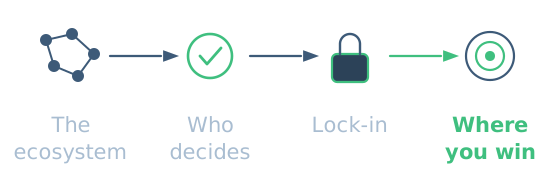
Market analysis usually arrives as a slide with four competitors on it and a number for the addressable market. Both are useful. Neither explains why deals are actually won and lost, which is normally about who is allowed to sign, what it would cost the buyer to leave their current supplier, and which network effects are already working against you.
The discipline
Treating a market as an ecosystem rather than a league table changes what you look for. The competitors matter, but so does the procurement authority: the person or the body that can actually commit, which in regulated and public-sector buying is rarely the person you are talking to. So do switching costs, because a better product loses to an incumbent whose data nobody can get out. And so do the reinforcing loops, because a market where every win makes the next win easier behaves nothing like one where it does not.
How SOSX runs it
The analysis is read-only. It never modifies the network, which makes it safe to run early and often. You can point it at the whole network or focus it on particular nodes or domains, and choose the depth: a competitor analysis, a mapping of procurement authority, or a full ecosystem analysis covering both and the structure around them.
Because it runs on the same network as everything else, the actors it reasons about are the actors already in the model, with their relationships and their citations attached, rather than a fresh list assembled for this document alone.
What you get
A market and ecosystem report covering the competitive landscape, procurement authority, switching costs and lock-in, and the reinforcing loops and network effects at work, plus the assumptions and method and an interpretation of what it all means. Every claim cites the source it came from, and the whole thing exports to PDF or Word.
The others in this group
The case has to survive a finance review, not just a workshop.
ROI analysis
“Does the money work, and when?”
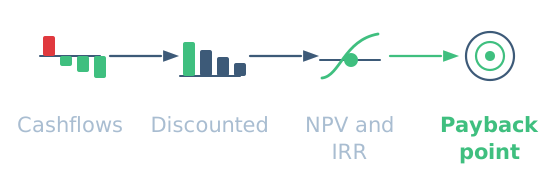
Net present value, internal rate of return, payback and profitability index over the horizon you set.
KPI tracker
“What are we measuring, and who owns it?”
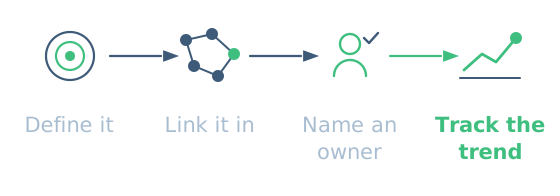
Performance measures defined against the model, with targets, trend and a named owner for each one.
Or see all the analysis tools. If you would rather we built the model and ran them for you, that is our system research, build and analysis service.