Analysis tools / Putting money on it
ROI analysis
“Does the money work, and when?”
Every serious proposal eventually meets someone whose job is to ask whether the money works. That conversation goes badly when the numbers arrive from a spreadsheet nobody can trace back to the plan, and it goes worse when the assumptions behind them turn out to be somebody's recollection of a supplier conversation.
The discipline
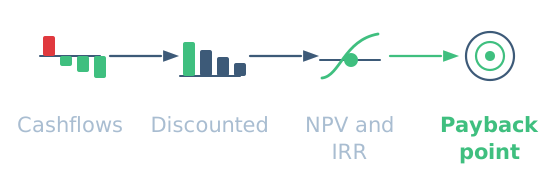
A financial case is four familiar numbers and one unfamiliar habit. Net present value tells you whether the thing is worth doing at your cost of capital. Internal rate of return tells you what return it implies. Payback tells you when the money comes back, which is the number operational people actually care about. The profitability index tells you how it compares against the other things competing for the same capital.
The habit is stating what each one rests on. A discount rate is a policy choice, a horizon is a judgement, and a cashflow profile is a set of assumptions about the world. Write them down and the case can be challenged properly. Leave them out and it will be challenged anyway, just less usefully.
How SOSX runs it
The financial parameters are discovered from the network's own nodes, so the case is built out of the model rather than beside it. You set the investment horizon and the discount rate, or take the defaults, and choose how deep to go: a quick net present value estimate for screening, a full discounted cashflow, or a run focused on sensitivity.
Sensitivity is treated as part of the analysis rather than an optional extra, and confidence is assessed explicitly, so the report can say which parts of the case are solid and which are resting on a thin parameter.
What you get
A report with a summary, the findings, the full cashflow schedule, the assumptions and method stated openly, and an interpretation section that says what the numbers mean rather than leaving the reader to infer it. It exports to PDF or Word, and the explainability companion traces each figure back through its conversions to the source it came from.
The others in this group
The case has to survive a finance review, not just a workshop.
Market analysis
“Who else is in this, and who decides?”
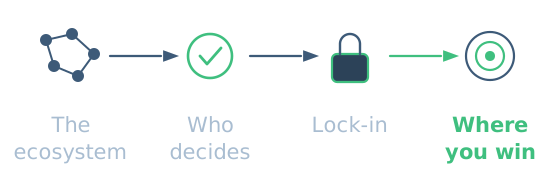
Demand, segmentation, the competitive landscape, who holds procurement authority, and where the lock-in sits.
KPI tracker
“What are we measuring, and who owns it?”
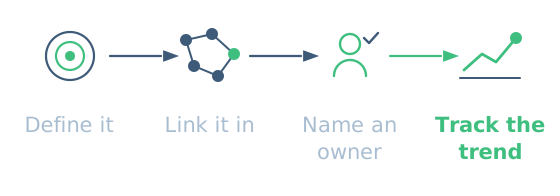
Performance measures defined against the model, with targets, trend and a named owner for each one.
Or see all the analysis tools. If you would rather we built the model and ran them for you, that is our system research, build and analysis service.